


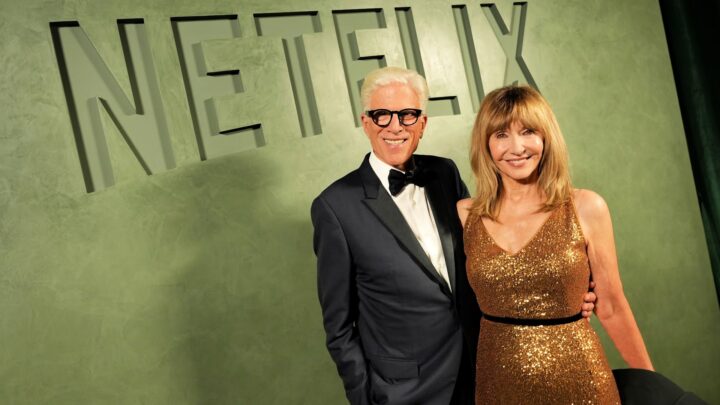
Ted Danson is laughing at himself again. He does it a lot. Not in the self-deprecating, “oh shucks” way actors sometimes use as camouflage, but in the way of a man who’s been around long enough to know that life is too short – and too absurd – to be taken seriously.
We’re in a café in Los Angeles, the sort of place where oat milk lattes outnumber regular coffees two to one, and he’s perched on a stool that makes his lanky six-foot-two frame look slightly precarious. Someone at the next table has already whispered, “That’s Sam Malone.” Another has muttered “Michael from The Good Place.” He hears it all the time.
“I’m still the bartender for some people,” Danson chuckles, stirring his coffee. “For others I’m the cranky doctor. Or the demon with great hair. It’s funny, you become a series of characters in other people’s lives. But this one” – he pauses, and the smile softens – “this new show is probably the closest to me.”
The show is A Man on the Inside, Netflix’s darkly funny new series inspired by the Chilean documentary The Mole Agent. Danson plays a widower who, restless in retirement, answers a private investigator’s ad and goes undercover in a nursing home. What begins as a quirky caper turns into a moving exploration of loneliness, resilience and the question of what it really means to live when so much has been lost.
“I’m nervous,” he admits, and the word lands heavily because Ted Danson is not the nervous type. “I want people to see this. It’s important. It’s about ageing, about connection, about not sweeping away the final chapters of life like they’re something we should all politely ignore.”
This is a man who has lived most of his career at the centre of television history. Cheers ran for eleven seasons, winning Emmys and making him the most recognisable barman in America. Becker gave him a second act as television’s grumpiest GP. He proved his dramatic chops in Damages. He reinvented himself yet again in The Good Place, wrestling with moral philosophy while wearing impeccable suits. He even showed up on Curb Your Enthusiasm, gleefully sending himself up.
And yet, sitting here with his sleeves rolled and hair a little tousled, Danson talks about A Man on the Inside with the intensity of a young actor on his first big break. “This is the quietest show I’ve ever done,” he says. “Quiet, but brave. There are moments where I don’t have the armour of comedy. No punchlines to hide behind. Just me, bare, in a room with the truth. That’s scary. But that’s where the power is.”
It’s tempting to call this a “late-career role”, but Danson bristles at the idea of winding down. At 76 he still radiates the kind of energy that makes you think he might leap up at any moment and start another twenty-episode season. He quotes Jane Fonda as a role model – “she just keeps going” – and grins. “I don’t want ticking to mean tapering off. I want more of what feels alive.”
He has good reason to talk about aliveness. The show forces him to sit with grief – his character is a widower navigating loneliness. Danson’s own life, by contrast, is grounded in love. He’s been married to actress Mary Steenburgen since 1995, and he still talks about her with the wonder of a man who can’t quite believe his luck. “Mary is my miracle,” he says simply. “You have to work on yourself to be ready for love like that. And once you have it, it colours everything. Even the way I approach this role.”
Love, loneliness, laughter: A Man on the Inside asks viewers to face them all. Danson knows it’s a risk in a TV landscape built on fast thrills and endless scrolling. “Humour is the key,” he insists. “If there wasn’t humour in this, it would be unbearable. Life demands humour, especially in grief. And the absurdity of ageing – I mean, some of it is just ridiculous. You have to laugh, otherwise you can’t face it.”
There’s another thread here too – activism. Danson has spent decades campaigning for the world’s oceans, lending his voice to causes that often swim below the surface of public attention. He sees a parallel with his new show. “Oceans, nursing homes – they’re both out of sight, easy to ignore, until suddenly they’re not. If this show makes people look more closely, care more deeply, then it’s done its job.”
That sense of purpose doesn’t stop him from being playful. He slips easily into anecdote, mimicking Larry David onCurb, or recalling the first night of Cheers when no one expected a sitcom in a Boston bar to last more than a season. “We thought we’d be cancelled,” he says, eyes sparkling. “Then people started laughing. And they never stopped.”
It’s a neat symmetry: Danson began in a bar where everybody knew your name, and four decades later he’s back in a place where names and stories are often forgotten – a nursing home. The mission, though, is the same: to remind us we’re human, we’re connected, and we all want to belong.
“What I hope,” he says, leaning forward, “is that someone watches this and feels seen. Maybe they call their mum in a nursing home. Maybe they talk about ageing a little more openly. If we can do that, if we can make someone feel less alone, then that’s everything.”
Danson drains the last of his coffee. The café chatter hums on. To the strangers at nearby tables, he is still Sam, still Michael, still the man with the perfect timing and the twinkle in his eye. But in this moment, he is simply Ted – candid, thoughtful, a little vulnerable, and still searching for truth through story.
“I want this show remembered for its heart,” he says at last. “For saying you’re not done yet. That life is still here, right up until the end.”
And with that, he flashes the grin that has been lighting up television screens for forty years – the grin that tells you Ted Danson, man on the inside, is still very much on top.





 Proudly Australian owned and operated