
Struggling to Get Comfy on a Plane? Here’s What Actually Helps


Unless you can afford the luxury of first or business class, you know how hard it can be to get comfortable on a long-haul flight. Whether you’re planning an international holiday or simply flying from Brisbane to Perth and back, travelling from Australia often means sitting on a plane for extended periods of time, which can result in significant discomfort and fatigue, not to mention an increased risk of blood clotting.
The good news is that a handful of genuinely evidence-based habits can make a real difference to how you feel getting off the plane, and where you choose to fly matters just as much as how you prepare.
Choose your seat with real intention
Where you sit changes almost everything about how a long flight feels. Seats over the wing sit closest to the aircraft’s centre of gravity, meaning passengers there feel roughly half the motion of those seated at the back during turbulence, worth knowing if you’re prone to motion sickness. The front of the economy cabin tends to be quieter overall, since jet engines mount under or behind the wings, and it also means earlier meal service and a faster exit once you land.
If legroom is your priority, exit row and bulkhead seats typically offer 35 to 38 inches of pitch, compared with the standard 30 to 32 inches, though bulkhead seats can also mean sitting close to families with young children. It’s worth checking a site like Seat Maps before booking, which maps out the specific quirks of different aircraft, including which seats have limited recline or sit uncomfortably close to a galley or toilet.
Take deep vein thrombosis seriously
Sitting still for long periods genuinely increases the risk of deep vein thrombosis (DVT), a blood clot that most commonly forms in the legs, and the risk climbs noticeably after around four hours of continuous sitting. The good news is that prevention is straightforward.
Move regularly. Aim to get up and walk the cabin roughly every 90 minutes to two hours. While seated, simple ankle circles and calf raises help keep blood circulating, and setting a phone alarm as a reminder is a genuinely useful trick, since it’s easy to lose track of time on a long flight.
Stay properly hydrated, and go easy on alcohol and caffeine, both of which contribute to dehydration and can make circulation issues worse. A reusable water bottle, filled after security, makes this considerably easier to stick to.
Compression socks remain genuinely useful if you’re at higher risk of DVT, whether due to age, a long flight, or other health factors. Look for a knee-length pair rated between 15 and 20mmHg, and put them on before you leave for the airport rather than at the gate, since your legs start swelling from the moment you sit down, including during the wait to board.
If you have any pre-existing health conditions or particular concerns about DVT risk, it’s worth having a quick conversation with your GP before a long-haul flight, particularly if you’ll be travelling for more than a few hours.
Pack for genuine comfort, not just entertainment
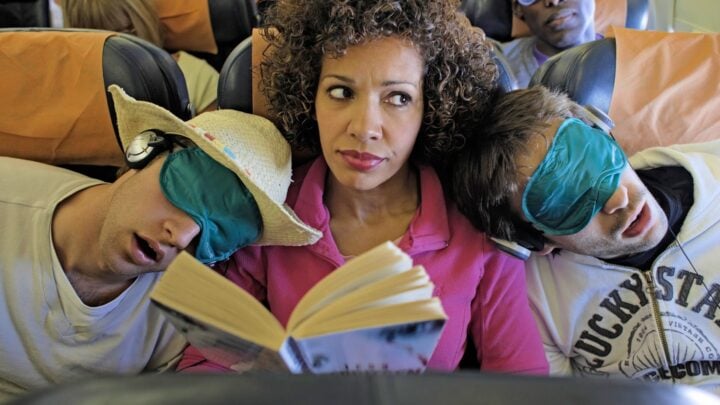
A few well-chosen items make a disproportionate difference on a long flight: a proper neck pillow, a good eye mask to block light and support better sleep, and earplugs or noise-cancelling headphones to dull engine noise and cabin chatter. Pack a layer too, even on a warm-weather trip, since cabin temperatures can run surprisingly cool.
Plan your sleep, don’t just hope for it
Long-haul sleep has to be actively arranged rather than left to chance. If you’re crossing multiple time zones, start shifting your sleep and meal times toward your destination’s schedule a day or two before you fly. Once on board, a window seat gives you something to lean against, while blackout-style eye masks have been shown to genuinely improve sleep quality by limiting light disruption.
The airline you choose matters, too
Great habits will only take you so far – the airline and aircraft you’re actually flying makes a genuine, measurable difference to comfort. According to the 2025 Skytrax World Airline Awards, considered the aviation industry’s benchmark passenger-voted ranking, the world’s best economy class seats currently belong to Japan Airlines, followed by Cathay Pacific, Korean Air, Singapore Airlines and Qatar Airways.
Japan Airlines leads by a wide margin, offering around 34 inches of seat pitch on its international widebody aircraft, two to three inches more than most competitors, thanks to an 8-abreast layout on select Boeing 787s instead of the usual 9-across. Cathay Pacific, Skytrax’s reigning World’s Best Economy Class winner two years running, has built its reputation on ergonomic seating, a quieter cabin and thoughtful extras like adjustable headrests. Singapore Airlines focuses less on raw legroom and more on consistency, with generous entertainment screens and the ability to preview and pre-select your meal up to eight days ahead, a small touch that genuinely helps on a fourteen-hour flight. Qatar Airways rounds out the top five with a strong all-around package, including one of the industry’s best entertainment systems, offering close to 8,000 titles through its Oryx One platform.
If comfort is genuinely a priority for your next long-haul trip, it’s worth checking which airline and aircraft you’ll actually be flying, not just chasing the cheapest fare, since seat pitch and cabin quality can vary considerably even within the same airline’s own fleet.
This article is general in nature and isn’t personalised medical advice. If you have specific health concerns about DVT risk or long-haul travel, speak with your GP before you fly.





 Proudly Australian owned and operated
Comments 1
Join the conversation. Comments are reviewed before they appear.
During local flights, as they are not long and don`t have to use the toilets, don`t bother with paying extra to choose my seat. Anything longer, re NZ, again don`t really bother. When my Husband was alive, would book our seats so he could have the aisle seat. My Sister and I flew from Sydney to Singapore, then after a few days there onto Manchester. We were lucky as the Lady in the 3rd seat, both flights, was quite happy to swap seats at different times.. Had to be in our allotted seats when landing.
Join the conversation
Tell us who you are to post a comment. We'll remember you next time.