


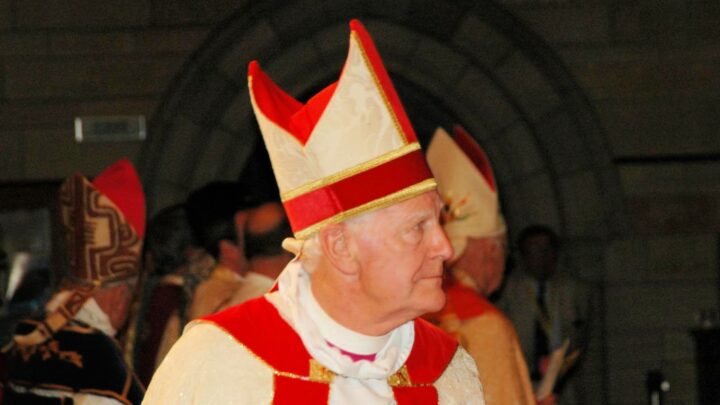
By Don Woolford
Peter Hollingworth devoted much of his life to fighting poverty, but will be remembered as the governor-general who was forced from office because of the way he handled sexual abuse cases as an archbishop.
Australia’s only clerical viceroy spent less than two years at Yarralumla before bowing to ferocious pressures and resigning in May 2003.
Peter John Hollingworth AO OBE, who died on Tuesday aged 91, was born in Adelaide on April 10, 1935.
He went to school in Melbourne and joined BHP before being conscripted for national service in 1953 when, after basic training, he was seconded to the chaplain’s office.
Back as a civilian, he completed a BA and Licentiate of Theology from Melbourne University in 1960, the year he married (Kathleen) Ann Turner, a physiotherapist he first met at a suburban church dance. They had three daughters.
After working for several years as a priest in an Anglican group ministry in inner-Melbourne, he joined the welfare agency the Brotherhood of St Laurence as chaplain and director of youth and children’s work in 1964.
He was to work for the brotherhood for 25 years, from 1980 as its executive director.
It was here that he became a household name for his campaigns against poverty. He harried governments, and irritated then-prime minister Bob Hawke, with his demands that more be done.
He wrote several books on poverty and, while still running the brotherhood, became canon of St Paul’s Cathedral in 1980 and a bishop in 1985.
Secular honours also came. He was on the inaugural list of Australian Living Treasures and Australian of the Year in 1991, a position he used to highlight the plight of the young unemployed.
In 1989 he was elected Archbishop of Brisbane, the first Australian-born to hold the position.
He was chosen by then-prime minister John Howard in 2001 to become Australia’s 23rd governor-general.
“I just gasped,” he said of the offer, which Mr Howard had prefaced by hoping he was sitting down.
And Dr Hollingworth, who’d spoken out on a wide range of issues – against voluntary euthanasia, mandatory sentencing, homosexual couples adopting children and imposing the GST on food, and in favour of better treatment of illegal immigrants and an apology to Aboriginal Australians – said one of his greatest challenges would be to keep his mouth shut.
Mr Howard’s choice was criticised, mainly because having an archbishop at Yarralumla, though he didn’t use the title there, could blur the lines between church and state.
That never became a problem. The problem was that skeletons in the diocesan cupboard in Brisbane started to rattle in early 2003.
The crux of the claims against Dr Hollingworth was that, as archbishop, he’d failed to act with compassion over claims of child abuse at a Toowoomba Anglican school.
They included that he’d allowed a bishop to continue preaching despite allegations he’d abused a 14-year-old girl in the 1950s and that he’d appointed a choirmaster facing similar claims to a church abuse committee.
Dr Hollingworth affirmed his detestation of child abuse and denied a cover-up, but caused great outrage with a remark on television that suggested in one case the girl had initiated the relationship.
He also acknowledged that his responses to the victims may have been too influenced by legal advice.
Soon the media and Labor were baying for his head, though Mr Howard said there were no grounds for dismissal.
Fresh ammunition came through a church report that said he’d acted “untenably” in allowing a self-confessed pedophile to remain a priest.
The Senate, with Labor and the minor parties combining, called for him to go; and an opinion poll found 76 per cent of Australians wanted him to quit.
Meanwhile, Labor digging uncovered a civil case in Victoria in which Dr Hollingworth was accused of raping a girl at a church youth camp in the early 1960s.
Dr Hollingworth denied it all and said he’d never been at a youth camp at the relevant time. But he stepped down pending the outcome of the case and Tasmanian governor Sir Guy Green flew in to take over his duties.
His accuser took her life and her family discontinued the case.
By then Dr Hollingworth was on medication for depression and his wife was battling breast cancer.
On May 25, saying the controversy was undermining the vice-regal office, he announced his resignation.
Dr Hollingworth went back to Melbourne and resumed some pastoral duties, including two mornings a week at a homeless centre and some preaching.
However his wish to work with victims of child abuse foundered on the opposition of support groups who didn’t want to be associated with him.
He generally kept a low profile, though he did attend the state funeral services of prominent politicians.
In a rare interview in 2005 he blamed his downfall on a “powerful secular culture keen to undermine anything religious”.
In 2016, however, he appeared before the royal commission into institutional sex abuse to apologise to a victim of a pedophile priest and admit he was wrong to let the priest continue to work.
A church inquiry in 2023 found he had committed misconduct by allowing the pedophiles to remain in the church.
Dr Hollingworth accepted the investigation’s findings, saying he “made mistakes and I cannot undo them” but had committed no crimes.
1800 RESPECT (1800 737 732)
National Sexual Abuse and Redress Support Service 1800 211 028





 Proudly Australian owned and operated
Comments 0
Join the conversation. Comments are reviewed before they appear.
Be the first to comment.
Join the conversation
Tell us who you are to post a comment. We'll remember you next time.