
Pokies are swallowing $2 million an hour from Australians


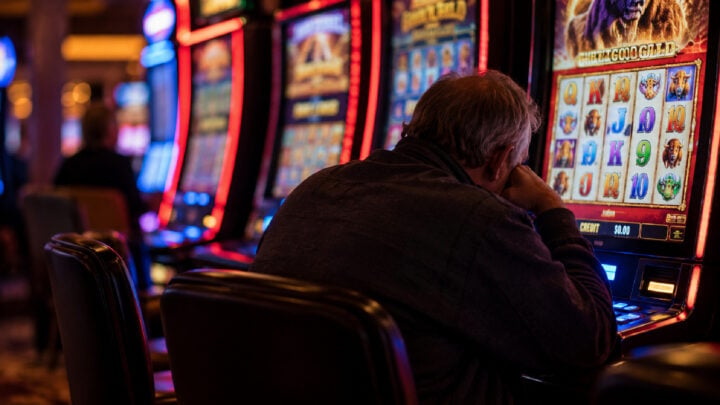
Australians lost almost $33 billion gambling in a single year — and 70 years after poker machines were legalised in NSW clubs, the losses are still climbing.
More than a quarter of a century ago, The Whitlams released a song with a title that didn’t leave much room for interpretation: Blow Up the Pokies.
Tim Freedman’s song told of the damage poker machines could do to a family and the struggle of someone trying to walk away from them.
Last month marked a rather sobering anniversary.
On September 19, 1956, poker machines were legalised in NSW clubs. Seventy years later, Australians are losing almost $2 million an hour on gaming machines, averaged across the year.
It’s a figure that sits uneasily alongside the cost-of-living conversation happening in households across the country. Australians compare supermarket prices, shop around for cheaper electricity, reconsider insurance premiums and wince when another bill arrives.
Yet the latest official Australian Gambling Statistics show almost $33 billion was lost to gambling in 2024–25.
That’s around $90 million every day, or $3.8 million every hour.
More than half of it — $17.44 billion — was lost on gaming machines. And the first six months of 2026 brought another record in NSW.
Seventy years on, another record
People in NSW lost $4.75 billion on poker machines in the first six months of 2026, $311 million more than during the same period last year.
Wesley Mission says losses during that period were increasing at almost twice the rate of inflation.
The June quarter produced another record at $2.38 billion — roughly $182 million a week, $26 million every day and almost $1.1 million every hour.
Poker machine losses in NSW have now remained above $1 million an hour for eight consecutive quarters.
Numbers measured in billions can become meaningless pretty quickly, so consider $33 billion another way.
At $50,000 apiece, it could buy about 660,000 new cars.
At $10,000 each, it could fund 3.3 million pretty spectacular Australian holidays.
Or you could shout every Australian a dinner worth more than $1,200 — although finding a restaurant booking might be tricky.
Australia’s gambling losses aren’t, of course, a giant pot of money that could simply be redirected to cars, holidays or dinner. The comparisons give some perspective to the sheer amount involved.
NSW leads the nation
NSW accounted for $13.71 billion of Australia’s $33 billion gambling expenditure in 2024–25, including $9.06 billion lost on gaming machines.
Victoria recorded $7.38 billion in total gambling losses and Queensland $6.84 billion.
Nationally, gambling expenditure equated to about $1,528 for every Australian adult. In NSW, it was approximately $2,035 per adult.
That doesn’t mean the average Australian actually loses that amount. Millions don’t gamble at all, and losses among those who do vary enormously. It’s a population measure that illustrates the scale of gambling expenditure.
More revealing is who is losing some of that money.
The NSW Auditor-General has reported that high-risk gamblers represented an estimated 1.7 per cent of gamblers but accounted for 17.1 per cent of gambling spending.
High-risk gamblers were estimated to have lost more than $1.4 billion on NSW club and hotel poker machines in 2023–24.
Why losing money after 60 can hurt differently
Research commissioned by Victoria’s responsible gambling authority has identified retirement, social isolation, boredom and bereavement among factors that can increase vulnerability to gambling harm among some older people.
There is also a financial reality that’s difficult to escape.
Someone who loses a substantial amount at 35 may have decades of employment ahead to rebuild their finances. Lose retirement savings at 70 and the opportunity to recover can be considerably smaller.
Many older Australians are also drawing on superannuation and savings or living largely on retirement income.
This doesn’t mean older Australians are the country’s biggest gamblers. NSW’s latest gambling survey suggests poker machine participation generally falls with age.
For those who do experience gambling harm, however, the effects can spread well beyond the person sitting at the machine.
The 2024 NSW Gambling Survey found 21 per cent of respondents had experienced some form of gambling harm, either through their own gambling or somebody else’s.
Poker machines were identified as the largest source of gambling harm in the state.
Seventy years — and the argument continues
The anniversary prompted Wesley Mission to renew its calls for tougher poker machine restrictions.
A survey commissioned by Wesley Mission and conducted by The Insight Centre found 84 per cent of 700 NSW adults surveyed said they did not trust the NSW Government to stand up to the gambling industry, while half believed the gambling lobby had too much influence on NSW politics.
Those figures come from Wesley-commissioned research rather than a government survey.
Wesley Mission CEO Rev Stu Cameron says seven decades of experience with poker machines provides enough evidence to act.
“We did not make seat belts voluntary and hope people would use them,” Cameron said.
Wesley wants poker machines switched off between midnight and 10am and mandatory account-based gambling with harm-minimisation measures.
Cameron argues pubs and clubs could continue trading during those hours without their machines operating.
“You can still have a beer. You can still have a meal. You can still see a band,” he said.
“We aren’t asking pubs and clubs to close. Just pull the plug on pokies after midnight.”
The NSW Government has announced its own package of reforms, including a statewide exclusion register and facial recognition technology designed to prevent excluded gamblers entering gaming rooms.
Those protections are expected to be introduced in 2028, rather than being in operation now.
Other measures include tighter marketing restrictions and upgrades to gaming infrastructure that would allow venues to introduce account-based gambling. However, the government has stopped short of making account-based play mandatory for every gambler.
There are around 87,000 poker machines across approximately 2100 NSW clubs and hotels.
Exactly how they should be regulated remains contested, with Wesley Mission arguing the government’s approach doesn’t go far enough.
Meanwhile, the scale of the losses is difficult to ignore. Seventy years after NSW clubs were first allowed to switch on their machines, Australians are losing almost $2 million an hour on pokies nationwide.
And more than a quarter of a century after The Whitlams sang Blow Up the Pokies, that’s one anniversary statistic few would want to celebrate.
Need help? If gambling is affecting you or someone close to you, Gambling Help Online provides free and confidential support 24 hours a day on 1800 858 858.





 Proudly Australian owned and operated
Comments 0
Join the conversation. Comments are reviewed before they appear.
Be the first to comment.
Join the conversation
Tell us who you are to post a comment. We'll remember you next time.