
On This Day: April 30


Pour yourself something warm. April 30 is a date that holds within it the end of one of the twentieth century’s most consequential conflicts, the quiet moment that changed how every human being on earth communicates, and a piece of Anzac history that belongs particularly to New Zealand.
1975 — The last helicopter out of Saigon
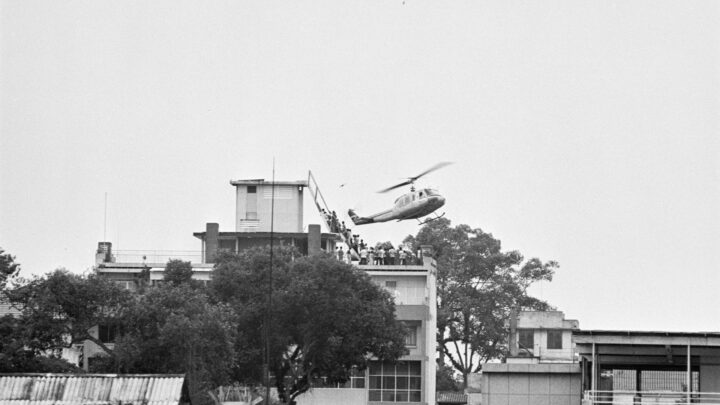
On April 30, 1975, Communist forces gained control of Saigon and South Vietnamese President Duong Van Minh – who had only been in office for two days – surrendered unconditionally, marking the end of the Vietnam War. The American helicopters had already left. The famous photograph of a CIA helicopter on a Saigon rooftop, people climbing the ladder in the dark, had been taken the day before.
For Australia, the date carries particular weight. More than 60,000 Australians served in Vietnam. Five hundred and twenty-one died. The war had divided the nation more bitterly than any conflict since conscription debates of the First World War – marches in the streets, families fractured, veterans who came home to silence rather than welcome. The fall of Saigon did not resolve that pain. In some ways it deepened it.
What it did end was the fighting. And on April 30, 1975, after thirty years of almost continuous conflict on Vietnamese soil – against the Japanese, against the French, against the Americans and their allies – that was not a small thing.
1993 — The web becomes a gift to the world
On April 30, 1993, the European organisation CERN placed the software required to operate a web server into the public domain under an open licence – ensuring its free dissemination and allowing the World Wide Web to flourish.
Tim Berners-Lee had invented the World Wide Web in 1989. But it was this decision – made on this date, in a research organisation in Geneva, to give it away – that changed everything. Not to sell it, not to license it, not to control it. To simply open it and let the world in.
Think about what has passed through that open door since 1993. Every email you have sent. Every photograph you have shared with your grandchildren. Every video call with someone you love on the other side of the world. Every article, every song, every recipe, every piece of news. Every column on Starts at 60.
It all flows through a door that was opened on April 30, 1993, by people who decided to give it away. That is one of the most consequential acts of generosity in human history, and it happened so quietly that most of the world didn’t notice.
1915 — New Zealand learns what happened on the beach
On April 30, 1915, when the first news of the Gallipoli landing reached New Zealand, a half-day public holiday was declared. The country stopped. People gathered. A nation that had sent its sons to a beach on the other side of the world learned, five days after the landing, what had happened there.
The ANZAC forces had gone ashore at Gallipoli on April 25. The news travelled slowly in 1915 – by telegraph and cable, across thousands of miles of ocean. And when it arrived in New Zealand, the government declared a half-day holiday so the country could absorb it together.
It is a detail that is easy to overlook beside the larger Anzac story, but it carries something important: the idea that news of this magnitude deserved collective time. That a nation should pause, and be together in what it had just learned. We could use more of that instinct, even now.
1945 — The end of the man who started it all
On April 30, 1945, with Soviet forces closing in from every direction and the Third Reich in its final hours, Adolf Hitler died by suicide in his underground bunker beneath the Reich Chancellary in Berlin. Eva Braun, whom he had married the day before, died beside him. The war in Europe ended eight days later.
Twelve years of Nazi rule. Sixty million dead. Six million murdered in the Holocaust. A continent in ruins. And at the end of it, a man in a bunker, unwilling to face what he had done. History contains few moments as stark as this one.
Also on this day…
In 1993, tennis champion Monica Seles was stabbed on court during a match in Hamburg by an obsessed fan of rival Steffi Graf. The wound itself was not life-threatening, but the psychological damage kept her out of the game for more than two years. She came back to win the Australian Open in 1996 – one of sport’s most remarkable returns. And in 1916, Germany became the first country to introduce daylight saving time, implemented to conserve energy during the First World War. A century later, Australians are still arguing about it twice a year.
Some days carry the full sweep of history in them. April 30 is one of them.
Come back tomorrow for another spin through the calendar.





 Proudly Australian owned and operated
Comments 0
Join the conversation. Comments are reviewed before they appear.
Be the first to comment.
Join the conversation
Tell us who you are to post a comment. We'll remember you next time.