
Lessons That Last: When curiosity took all afternoon



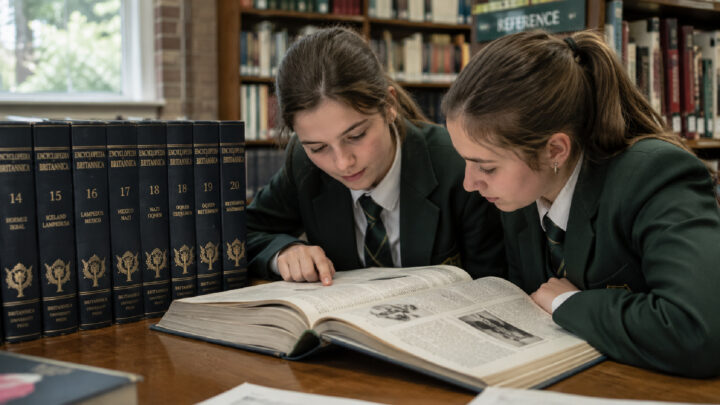
Before Google, finding the answer was part of the adventure
Every now and then, I’ll hear someone say, “I’ll just Google it” or “I’ll ask AI”, and it takes me straight back to school.
It also makes me wonder how on earth we ever finished an assignment, because finding the information could swallow an entire Saturday and not because the work was harder.
I can still picture heading into the library with a few questions scribbled on a scrap of paper, convinced I’d be finished before my two free classes were. A couple of hours later I’d walk out with three books under my arm, only one of which had anything to do with the assignment.
I’d head there determined to learn everything about volcanoes, but somewhere between the encyclopaedias and the history shelves I’d become fascinated by Vikings, UFOs, or the adventures of some long-forgotten explorer.
The homework eventually got finished.
Well, maybe sometimes.
The bookshelf that held the world’s knowledge
There was something almost magical about a full set of encyclopaedias, whether it was World Book, Encyclopaedia Britannica or another collection, those neatly matched volumes seemed to contain the answer to absolutely everything.
I remember visiting friends whose families owned a complete set. They looked mighty impressive lined up across an entire bookshelf.
Looking back, I assumed they must all be geniuses.
Turns out they just had better shelving.
There was also a certain respect reserved for those enormous books as you didn’t casually flick through an encyclopaedia; you wrestled it onto the table.
And if you happened to drop one on your foot, you weren’t walking properly for the rest of the afternoon.
Sister Miriam’s library
I never really understood the Dewey Decimal System.
Thankfully, Sister Miriam did.
She was the librarian at our convent school, although we cheekily nicknamed her “Fossils” behind her back. Looking back now, that probably says more about a bunch of mischievous school kids than it ever did about Sister Marie-Anne. We were convinced she’d been around longer than the convent itself.
She was one of those remarkable people who seemed to know every book in the building.
You’d wander into the library mumbling something about volcanoes, Captain Cook or ancient Egypt, and she’d point towards exactly the right shelf without even stopping to think.
I honestly believed it was some sort of superpower.
The other thing Sister Marie-Anne possessed was extraordinary hearing.
You might think you were quietly whispering to a mate three rows away, but somehow she’d appear beside you as if she’d materialised from between the bookshelves.
Then came the finger. One long, bony finger gently — but very deliberately — jabbed into the middle of your back.
Not enough to hurt, but just enough to let you know the library was for reading, not talking.
She wasn’t simply looking after books, she was quietly teaching a generation to respect them.
Before we had Google
When you couldn’t find the answer in an encyclopaedia, somebody always seemed to know.
It might have been a teacher, maybe the librarian, or even the old bloke down the road who could identify every native bird by its call and repair your lawnmower before lunch.
Australian suburbs were full of unofficial experts. Nobody had a website, nor a YouTube channel.
But somehow they knew things.
And if they didn’t, they usually knew someone who did.
The best lesson of the week
Nothing — and I mean nothing — lifted classroom morale faster than hearing the television trolley rumbling down the corridor.
The lesson hadn’t even started and everyone knew it was going to be a good day.
The teacher would wrestle with the rabbit-ear antennas while someone was sent to close the curtains. Another lucky student scored the important job of turning off the lights.
For an hour, school felt less like work and more like an adventure. Even if half the class was secretly hoping the teacher couldn’t get the picture tuned in properly.
The search was part of the education
Looking back, I wouldn’t swap today’s technology for anything.
Being able to find almost any answer in seconds is extraordinary. But I do miss the search.
I miss wandering into the library looking for one thing and walking out fascinated by something completely different.
I miss discovering books I’d never planned to open. And I miss the quiet satisfaction that came from finally finding the answer after you’d worked for it.
Maybe that’s what curiosity looked like before the internet.
It took a little longer, but somehow, it stayed with you a little longer as well.
Your turn
Did your family own a set of encyclopaedias? Who remembers the Dewey Decimal System, card catalogues, microfiche readers or spending Saturday mornings at the local library?
And did you have a librarian or teacher like Sister Marie-Anne — someone who seemed to know exactly where every answer could be found?





 Proudly Australian owned and operated
Comments 0
Join the conversation. Comments are reviewed before they appear.
Be the first to comment.
Join the conversation
Tell us who you are to post a comment. We'll remember you next time.