

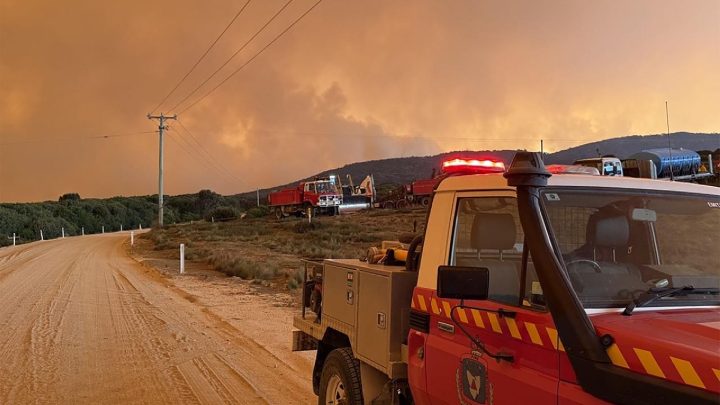
More homes have likely been destroyed by a raging bushfire on a remote island, as the latest national outlook highlights a heightened fire risk for the summer ahead.
The blaze on Tasmania’s Flinders Island had burned almost 15,000 hectares as of Thursday, more than 10 per cent of its land area.
Six properties have been damaged or destroyed, with the figure expected to rise.
Another two or three buildings were likely lost, with further assessments to take place on Friday, Tasmania Fire Service incident controller Steven Richardson told ABC News.
The out-of-control fire, which spread rapidly on Wednesday, broke northern containment lines on Thursday night.
Weather conditions, featuring winds of up to 50km/h, were expected to worsen on Friday ahead of forecast weekend rain which could bring some relief.
Some people remained in their homes in parts of the island’s north and some were well-prepared to defend their properties, Mr Richardson said.
“They have the appropriate resources,” he said.
“Unfortunately there are some who are not well prepared and they are just hoping for the best and sheltering in place.”
About a dozen people, a dog and wombat have been evacuated. A police boat is anchored off the coast in case anybody else needs help.
Emergency warnings remained in place for Killiecrankie, Mount Killiecrankie Recreation Area, Leeka and Mount Tanner with lesser warnings covering surrounding areas.
Additional firefighting resources have been sent by barge to the island, which is home to 900 people, while Aboriginal rangers have also assisted efforts.
The latest Seasonal Bushfire Outlook, published on Friday, urged Australia’s southern states to prepare for a dangerous bushfire season as wet spring conditions come to a sudden end.
The outlook by the Australasian Fire Authorities Council paints a grim picture for western Victoria extending into South Australia and north of the Murray River beyond Griffith.
Regions surrounding Perth and the national parks to the south of the Western Australian capital are also facing an increased risk of bushfires.
The council reports in some parts of Australia, existing warnings from spring and winter remain in place.
The upper hunter region west of Newcastle, much of the Northern Territory, the east coast of Tasmania, and the southern NSW coast remain drier than usual.
Risk of bushfire in each of these regions has been driven persistent low soil moisture, high fuel loads and forecast dry conditions.
Only Queensland is expected to face an average bushfire risk this summer having passed through its spring fire season largely unscathed.
Council chief executive Rob Webb said the importance of preparing early cannot be overstated.
“Everyone can play an important role in bushfire safety by making a bushfire plan, preparing early, and monitoring local conditions both at home and on holiday,” Mr Webb said.
“Local fire authorities will be monitoring bushfire risk this season so you can stay up to date and ready to act if there is an emergency.”
The Bureau of Meteorology has forecast a high likelihood of unusually high temperatures in all parts of the country and the impending strong El Nino expected to hit the Pacific more than inland Australia.







 Proudly Australian owned and operated
Comments 0
Join the conversation. Comments are reviewed before they appear.
Be the first to comment.
Join the conversation
Tell us who you are to post a comment. We'll remember you next time.