
‘I don’t want to become smaller’: How AI changed Stefano at 60



THE BIG READ
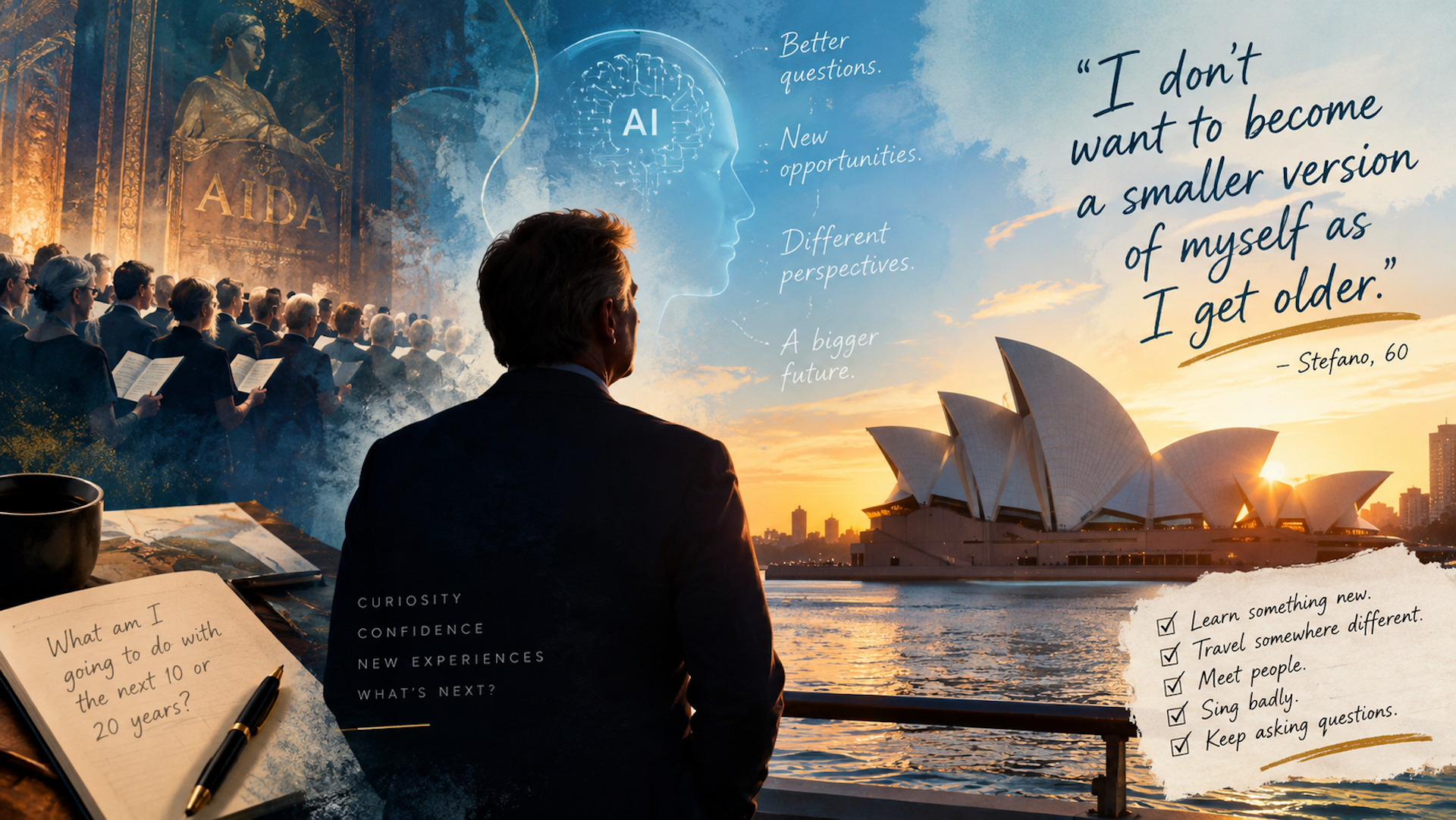
At 60, Stefano never imagined he would find himself standing inside the Sydney Opera House performing Verdi’s Aida.
He certainly never imagined artificial intelligence might have something to do with getting him there.
A self-described introvert who had long believed singing wasn’t really his thing, Stefano had plenty of perfectly sensible reasons not to join a choir. He didn’t know anybody. He might be terrible. He’d be walking into a room full of strangers and, at 60, did he really want to become a complete beginner again?
Then he started pulling those excuses apart with AI.
“I’d say, ‘I’m not really that sort of person’,” Stefano told Starts at 60. “And the obvious question back is, ‘What sort of person?’
“Then you get down to the real issue: you’re worried about walking into a room where you don’t know anyone, you’re worried you’ll be terrible at it, and you’re probably slightly embarrassed about being a beginner at 60.”
Once he’d articulated what was actually stopping him, it didn’t seem nearly as formidable.
So he joined the choir.
“I’m still not entirely sure I can sing,” he jokes. “The choir may have an opinion on that.”
He went on to perform Aida at the Sydney Opera House, an experience made particularly poignant by the thought of his opera-loving father.
But for Stefano, the real achievement wasn’t singing.
“It was proving to myself that at 60 I can still walk into somewhere completely unfamiliar, meet new people and be bad at something for a while. I actually think being a beginner again is quite healthy.”
From work tool to sounding board
Stefano’s experience echoes many of the themes explored in Unreal: When AI Becomes Us, a new six-part Audible Original from Walkley Award-winning journalist and documentary maker Marc Fennell examining the increasingly personal place artificial intelligence occupies in our lives.
Stefano didn’t set out looking for an AI sounding board.
He works in procurement and began using AI in a fairly conventional way: reviewing documents, analysing numbers, drafting emails and solving work problems.
Then, gradually, the questions changed.
“I started asking questions that had nothing to do with work,” he says.
“Things about holiday planning, money, retirement, family, things that were bothering me, or just thoughts I couldn’t quite get straight in my own head.”
Eventually he realised AI had become more than another piece of office software.
“I was using it as a sounding board as much as a work tool,” he says.
Importantly, Stefano doesn’t describe AI as a friend and doesn’t want it making decisions for him.
“It’s more like having somewhere you can throw an unfinished thought and say, ‘What am I missing here?’ Sometimes that’s surprisingly useful.”
‘What am I going to do with the next 10 or 20 years?’
That’s where Stefano’s story becomes less about technology and more about getting older. At 60, his children are preparing to leave home and retirement may not be imminent, but neither is it some distant event on the horizon.
After decades in which life had an obvious structure – work, mortgage, children, school and the relentless business of raising a family – Stefano found himself confronting a deceptively simple question.
“What exactly am I going to do with the next 10 or 20 years?”
Other questions followed.
“What am I interested in when I’m not at work? What am I going to do when the children don’t need us in quite the same way? Am I going to keep learning things and meeting people, or slowly make my world smaller?”
He laughs at any suggestion this amounted to a dramatic midlife crisis.
“I wasn’t sitting in a darkened room contemplating the meaning of life,” he says.
“It was more a realisation that this next stage could actually be quite interesting – but you probably have to make a conscious effort to make it that way.”
AI at the bank – and the doctor’s surgery
Some of Stefano’s most useful applications of AI are far less philosophical.
When he wanted to negotiate a better home-loan interest rate, for example, he asked AI to pretend to be the bank.
He had it challenge his arguments, anticipate what the bank might say, identify the information he should have ready and help him practise his responses.
By the time he made the call, Stefano says he was better prepared and more confident – and achieved the outcome he wanted.
He’s also used AI to help make sense of complicated medical reports.
“Sometimes you get a specialist’s report and it is technically written in English, but it might as well be another language,” he says.
He asks AI to explain terminology in plain English and, crucially, suggest questions he might want to put to his specialist.
“It doesn’t replace the doctor – absolutely not,” he says.
“But it means I can walk into the appointment understanding more and having better questions to ask.
“That’s empowering, particularly as you get older and inevitably start dealing with more specialists, reports and tests.”
That distinction matters. AI tools can produce inaccurate or misleading information, and medical, financial and other important decisions should still be checked against reliable sources and appropriately qualified professionals.
Stefano knows that from experience.
“Anyone who uses AI a lot and says it never makes mistakes probably isn’t checking it,” he says.
He’s seen it misunderstand questions, make assumptions, get figures wrong and deliver answers with great confidence that don’t withstand scrutiny.
His response is to push back.
“Go back to the original document. Show me where you got that from. Don’t assume. Recalculate it.”
Don’t ask AI to tell you you’re right
Stefano has also learned that the quality of the conversation depends partly on what you ask.
“Don’t just agree with me. Tell me where my argument is weak,” is one of his instructions.
That can be particularly useful when emotions are running high.
He sometimes drafts work emails while annoyed, convinced they’re perfectly reasonable because the facts are correct.
AI may see it differently.
It can point out that while his argument may be factually sound, the tone is likely to make the recipient defensive and make it harder to achieve what he wants.
“There have certainly been times when I’ve read its response and thought, yes, I’m right – but I’m also being a bit harsh or emotional about it.”
So he changes the email.
“Rather than asking, ‘Tell me why I’m right’, ask, ‘What am I not seeing?’”
But can AI become too easy?
There is a more uncomfortable side to all this.
An AI chatbot doesn’t become impatient. You can ask the same question repeatedly, revisit an issue at midnight and go around in circles without hearing: “We’ve already talked about this five times.”
For someone naturally shy or introverted, Stefano accepts there’s a risk that convenience could become dependence.
“Yes. I think that’s a legitimate concern,” he says.
But he has also found the opposite can happen.
If he’s angry, confused or upset, talking through an issue first can help him distinguish what actually happened from what he’s feeling about it.
“Then I’m in a better position to talk to my wife, family, friends or whoever is involved.”
During one particularly personal conversation involving grief, Stefano says the AI appeared to pick up something in the way he was communicating and asked whether he was okay.
It caught him by surprise.
“I don’t think a computer replaces human empathy, and I wouldn’t pretend it does,” he says.
“But it showed me that these systems are increasingly capable of recognising that sometimes the person asking the question matters more than the question itself.
“And in that particular moment, I appreciated it.”
His boundary is nevertheless clear.
“You can’t outsource your marriage, your relationship with your children or a friendship to a computer.”
Nor, he says, should people outsource professional medical or financial advice to it.
“Use it to make yourself a better-informed human being, not to avoid being one.”
‘This technology isn’t for people like me’
For older Australians wary of AI, Stefano has a simple suggestion: don’t start by trying to “learn AI”.
Start with a problem.
Have a medical report you can’t understand? Ask it to explain the terminology in everyday language, then check that information with your health professional.
Want to negotiate with your bank? Ask it to role-play the bank manager before you make the call.
Planning a holiday? See what questions it can help you answer.
Received a confusing letter? Ask it to explain what’s being requested, while taking care not to enter sensitive personal or financial information.
And talk to it normally.
“You don’t have to learn computer language or become some sort of technology expert,” Stefano says.
In fact, he believes people in their 60s and 70s may possess an advantage that doesn’t receive enough attention in conversations about new technology.
“We’ve got decades of experience against which to judge what it tells us.
“You don’t hand your brain over to AI. You bring your experience to it.”
Becoming bigger, not smaller
Ask Stefano whether AI has changed him and he pauses over the question.
He’s more curious, he says. More prepared to investigate things he doesn’t understand. More willing to question himself.
And perhaps more willing to be uncomfortable.
That choir is evidence of that.
But his most telling answer has little to do with artificial intelligence.
“I don’t particularly want to become a smaller version of myself as I get older,” he says.
“I don’t want the list of things I do to gradually get shorter. I’d rather add things.
“Learn something new. Travel somewhere different. Meet people. Sing badly. Keep working while I still enjoy the work. Ask questions. Occasionally discover I’m wrong.”
AI didn’t give Stefano that philosophy.
But having something capable of questioning his assumptions helped him recognise it.
“That’s the sort of 60-year-old I want to be,” he says.
“And I’m still very much working it out.”
Want to hear more?
Stefano’s experience reflects many of the themes explored in Unreal: When AI Becomes Us, the new six-episode Audible Original from Walkley Award-winning journalist and documentary maker Marc Fennell. Unreal: When AI Becomes Us is available now on Audible.





 Proudly Australian owned and operated
Comments 3
Join the conversation. Comments are reviewed before they appear.
Such an interesting read
Thanks for the article, had to laugh at the photos, maybe AI generated
Great article .
Join the conversation
Tell us who you are to post a comment. We'll remember you next time.