


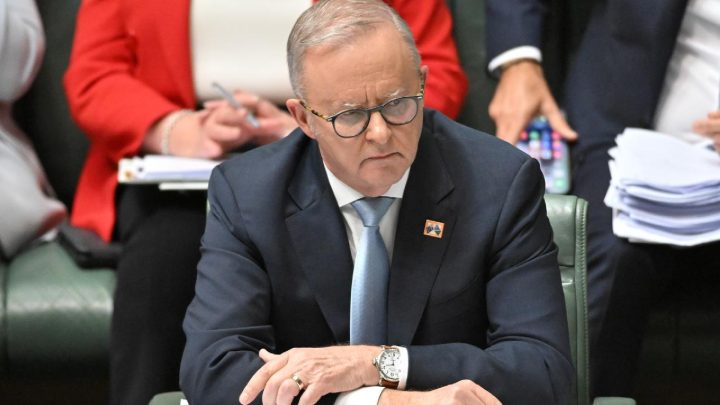
Bill Shorten has warned federal Labor against ignoring the lessons of Victoria’s devastating election defeat, as voters increasingly turn their backs on the major parties.
By Lucinda Garbutt-Young in Canberra
Federal Labor leaders have been warned they would be wrong to downplay their party’s catastrophic Victorian election loss as merely the result of state failings.
Victoria has turned blue after the Coalition swept to victory on Saturday, potentially taking two-thirds of lower house seats and leaving Labor struggling to form opposition.
Prominent federal Labor representatives, including Deputy Prime Minister Richard Marles and Victorian frontbencher Sam Rae, were quick to attribute the loss to state party woes.
But former federal Labor leader Bill Shorten, who lost the 2019 election after being widely tipped to win, said it was important to recognise that Victoria accounted for a quarter of the nation’s population and could act as a bellwether for the next national poll.
Shorten sounds the alarm
“There’s no doubt it was largely a Victorian reaction, but the question really is whether there is anything in the way the state was running itself that provides lessons not just for federal Labor, but for all main parties,” he told AAP.
Voters expected governments to work for the public rather than themselves and might question huge sums being spent on projects such as the Suburban Rail Loop while local potholes went unrepaired, Mr Shorten added.
“If you draw the conclusion that there is nothing to see here federally, that would be an interesting, possibly brave, interpretation,” he said.
One Nation and Greens shake up politics
The election was the first genuine four-way race in Australian history, analysts said, with One Nation picking up 20 per cent of the primary vote and the Greens emerging a close fourth behind Labor.
Much of the Coalition’s success was due to preference flows, with its primary vote of about 36 per cent low by historical standards.
Disillusioned voters were lending their support to traditionally minor parties on a term-by-term basis, Australian National University associate professor Jill Sheppard said, rather than tearing up the two-party system.
“What we are seeing instead is voters increasingly confident they can step away from major parties and vote elsewhere if those parties stop listening to them,” she said.
Minor parties were better at speaking to specific economic circumstances or migrant communities than their larger counterparts, eminent political scientist John Wanna told AAP.
“Labor tends to be more generic across electorates, as do the Liberals,” he said.
All eyes turn to NSW
As well as sounding alarm bells for federal Labor, the Victorian election result will bring into sharp focus the battle facing the NSW government to retain power at the March election.





 Proudly Australian owned and operated
Comments 0
Join the conversation. Comments are reviewed before they appear.
Be the first to comment.
Join the conversation
Tell us who you are to post a comment. We'll remember you next time.