
Don’t play my song: 12 times musicians took on politicians


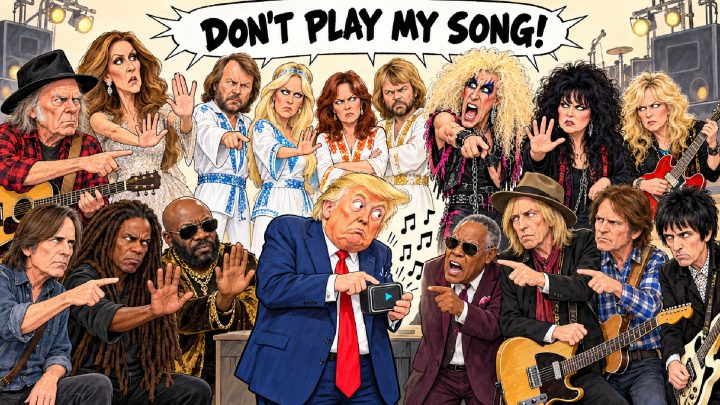
A familiar chorus can lift a crowd, stir memories and make a politician’s entrance feel positively presidential… then the person who made the record finds out.
Neil Young’s latest legal action over the use of Rockin’ in the Free World is another chapter in a long-running battle over campaign soundtracks.
The musician is seeking US$10 million from Trump 47 Committee Inc., alleging the song was played without permission at an October 12 rally in Ohio. The allegations have yet to be determined.
But Donald Trump is hardly the only politician to discover that liking a song doesn’t mean its creator likes you back. From Clive Palmer’s expensive encounter with Twisted Sister to Barack Obama’s unwanted soul soundtrack, here are 12 memorable clashes.
As you’ll soon discover, Trump is something of a serial offender when it comes to choosing campaign songs whose creators would rather he hadn’t.
1. Neil Young and Donald Trump: Rockin’ in the Free World
With its roaring guitars and rousing chorus, Young’s 1989 classic might sound like an obvious rally anthem. Its verses, however, paint a much darker picture of American life.
Young previously sued Trump’s re-election campaign in 2020. His new complaint, filed in Virginia on October 26, 2026, alleges that the earlier case ended with a promise not to use the song again without a licence and his permission.
The latest defendant is a different organisation, Trump 47 Committee Inc. Young wants damages and an injunction, arguing that the association falsely suggests political support.
2. Twisted Sister and Clive Palmer: We’re Not Gonna Take It
Australian voters heard plenty of Palmer’s version during the United Australia Party’s 2019 election advertising campaign. The rewritten refrain declared that Australians were “not gonna cop it”.
Music publisher Universal Music took legal action over the adaptation of Twisted Sister’s 1984 hit.
In April 2021, the Federal Court ordered Palmer to pay $1.5 million in damages for copyright infringement, plus costs. The court heard that licensing negotiations had taken place before the advertisements went ahead without an agreement.
Changing the words had not solved the copyright problem.
3. Celine Dion and Donald Trump: My Heart Will Go On
A song forever associated with the Titanic was always an intriguing choice for a campaign hoping to project confidence.
After a video of Dion performing My Heart Will Go On appeared at Trump’s August 2024 rally in Bozeman, Montana, her management and record label issued a statement saying the use was unauthorised and did not carry her endorsement.
Then came the wonderfully economical closing line: “… And really, THAT song?”
Few artists have made their objection quite so neatly.
4. ABBA and Donald Trump: Dancing Queen and The Winner Takes It All
Even ABBA’s dependable party starters became a political headache.
In August 2024, the Swedish group’s representatives demanded the removal of footage featuring their music and videos at Trump events. Songs reported in the dispute included Dancing Queen and The Winner Takes It All.
ABBA’s team said it had received no request and granted no permission. The Trump campaign said it held licences through performing rights organisations BMI and ASCAP.
The disagreement illustrated a recurring complication: an artist’s approval and a campaign’s claimed licensing arrangements are different questions.
5. Heart and Sarah Palin: Barracuda
Sarah Palin’s high-school basketball nickname was “Sarah Barracuda”, making Heart’s hard-rock classic an almost irresistible choice for the Republican campaign in 2008.
Ann and Nancy Wilson were considerably less enthusiastic.
Their representatives sent a cease-and-desist notice over the song’s use as a theme for the vice-presidential nominee. The sisters publicly distanced themselves from Palin’s politics.
Asked about the episode years later, Ann Wilson recalled that they had demanded the campaign stop and, as far as they knew, it did. A convenient nickname hadn’t amounted to an endorsement.
6. Jackson Browne and John McCain: Running on Empty
Browne’s road-weary classic became the soundtrack to a Republican advertisement attacking Barack Obama’s energy policies during the 2008 presidential contest.
Browne sued John McCain, the Republican National Committee and the Ohio Republican Party.
The dispute ended in a settlement in 2009, accompanied by a public apology over the song’s use without permission and a pledge to respect artists’ rights in future.
For Browne, it was a fight over the impression that his music — and potentially his support — could be recruited into somebody else’s campaign.
7. Eddy Grant and Donald Trump: Electric Avenue
Grant’s dispute involved a social media video rather than a rally playlist.
A 2020 animation shared by Trump used Electric Avenue alongside a speeding Trump train and a slow-moving Joe Biden handcart.
Grant sued. In September 2024, a federal judge found Trump liable for copyright infringement, rejecting his fair-use defence. The parties settled that November before damages were determined, with the terms undisclosed.
The case provided a costly reminder that music used behind an online political joke still carries rights.
8. Isaac Hayes’ estate and Donald Trump: Hold On, I’m Comin’
The exuberant Sam & Dave hit was co-written by Isaac Hayes and David Porter. Decades later, Hayes’ family challenged its repeated use at Trump campaign events.
The estate sued in 2024, and a judge ordered the campaign to stop playing it while the litigation proceeded.
There has since been a resolution. In February 2026, the Hayes family and estate announced that the dispute had been mutually resolved and said they were satisfied with the outcome.
Their announcement did not disclose settlement terms.
9. Sam Moore and Barack Obama: Hold On, I’m Comin’
The same song had caused trouble on the other side of American politics years earlier.
During Obama’s 2008 campaign, Sam Moore — one half of Sam & Dave — objected to its use at rallies.
Moore had not endorsed Obama and did not want the recording to create that impression. The campaign agreed to stop using it.
The episode is a useful reminder that these arguments stretch across party lines. A politician might hear an irresistible message of hope; the singer might hear an endorsement he never agreed to give.
10. Tom Petty’s family and Donald Trump: I Won’t Back Down
After I Won’t Back Down played at Trump’s June 2020 rally in Tulsa, Petty’s family issued a cease-and-desist warning.
In a statement signed by his widow, former wife and daughters, the family said the late musician would not have wanted the song used for that campaign.
They described it as a song for underdogs and expressed concern that listeners might interpret its use as their support.
For a record built around standing your ground, the family’s response was entirely in keeping with its title.
11. John Fogerty and Donald Trump: Fortunate Son
Few campaign choices have carried quite as much lyrical irony as Fortunate Son.
Creedence Clearwater Revival’s 1969 recording attacks the privilege that allowed some well-connected Americans to avoid the burdens borne by others.
When it appeared at Trump rallies in 2020, songwriter John Fogerty objected and announced a cease-and-desist letter.
Speaking to CNN, Fogerty said his voice was being played at events whose politics he did not support. For him, the objection involved both the association and the apparent misunderstanding of the song itself.
12. Johnny Marr and Donald Trump: Please, Please, Please, Let Me Get What I Want
The Smiths’ wistful plea might seem an unusual addition to a political rally playlist. Guitarist and co-writer Johnny Marr certainly wasn’t pleased to find it there.
In January 2024, after footage circulated of the song playing at a Trump event, Marr publicly objected and demanded it stop.
His response was blunt, profane and very difficult to mistake for campaign support.
Another politician had found a song he wanted. One of the people who created it wanted absolutely no part in the arrangement.
For anyone wondering why these rows don’t all end the same way, the circumstances matter. Playing a recording at a public event and putting it into a campaign advertisement involve different rights. Australia’s APRA AMCOS guidance also warns political users about creating a misleading impression of an artist’s endorsement. An objection, a legal demand and a court finding are three different things.
For the musicians, though, the concern is often straightforward: hearing your song at a rally can make it sound as though you’re standing on the stage too.





 Proudly Australian owned and operated
Comments 0
Join the conversation. Comments are reviewed before they appear.
Be the first to comment.
Join the conversation
Tell us who you are to post a comment. We'll remember you next time.