


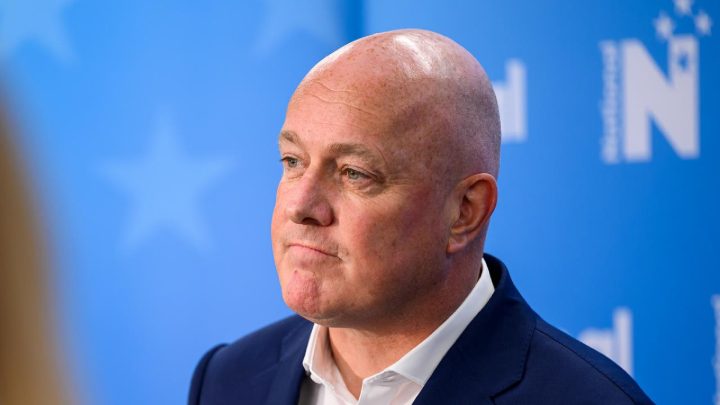
New Zealand could face weeks of political uncertainty after final election results left neither side with a parliamentary majority, handing a fledgling political party considerable influence.
By Ben McKay in Hobart
New Zealanders could be in for a long wait for their next government after final election results produced a hung parliament.
Three weeks after the November 7 election, the electoral commission’s final tally of votes has wiped out the conservative coalition’s initial narrow majority.
The coalition of the National, ACT and NZ First parties now has 65 seats.
The Labour-led left has 58, with Opportunity’s seven seats also bringing that bloc to 65.
That means newcomers Opportunity, a newly elected teal force, will play a critical role in coalition negotiations.
Qiulae Wong’s party will have to choose whether it supports Chris Luxon’s government for a second term.
The alternative is to join the left bloc, though that may produce a deadlocked parliament, plunging New Zealand into uncertainty.
The prime minister, Labour leader Chris Hipkins, Wong and other party leaders are due to address the media in the coming hours.
Special votes change the political picture
Preliminary results on election night showed the coalition with 67 MPs in a 131-seat parliament.
The addition of 485,000 special votes – from overseas and out-of-electorate voters, as well as late enrollers – altered the final make-up of parliament.
Luxon’s National lost two tight seats, with Labour candidates in Hamilton East and Wairarapa winning their races, while the Greens also gained a seat.
The outcome is certain to raise questions over New Zealand’s electoral system, a mixed-member proportional (MMP) format.
Implemented in 1996 after a referendum, MMP elects a mixture of local and list MPs based on two votes: the electorate and nationwide party vote.
However, the collapse of support for Luxon’s National has led to a distortion of the intended proportionality, meaning the centre-right party will enjoy more representation than its party vote would allow.
To a lesser degree, the Maori Party will also benefit from this quirk, known as the overhang.
The tightness of the result means this distortion has effectively decided the outcome.
New party faces a difficult choice
The final numbers signal a dilemma for Opportunity, which has said it is open to siding with either side of politics but faces policy problems in dealing with the right.
Wong signalled she would attempt to negotiate with National, as it returned the most MPs, even though Luxon ruled out working with Opportunity during the campaign.
Opportunity named five non-negotiable “bottom lines” as its price for supporting a government.
They are breaking up the supermarket duopoly, integrity and donation reforms, a 10-year health funding plan, banning exploitative fishing and improved climate action.
NZ First and ACT have diametrically opposed climate policies to Opportunity, with ACT also unlikely to back donation reforms, and NZ First against its fisheries plans.
Wong has also said her party could not support NZ First leader Winston Peters as foreign minister or the Maori policies of the coalition’s first term.
There is also the possibility of a recount, given a margin of just 81 votes in Wairarapa.





 Proudly Australian owned and operated
Comments 0
Join the conversation. Comments are reviewed before they appear.
Be the first to comment.
Join the conversation
Tell us who you are to post a comment. We'll remember you next time.