
Deborah Knight’s front row seat to the world


The BIG Sunday Interview, with Matt Lennon
On the morning of September 11, 2001, Deborah Knight was thousands of kilometres from home, travelling with then–Australian Prime Minister John Howard on what was meant to be a routine diplomatic visit to the United States as part of the media delegation. Instead, she found herself reporting from the epicentre of one of the most shocking days in modern history.
The first reports filtered through as the travelling media pack shadowed Howard’s official engagements in Washington. News bulletins began to speak of a plane striking the World Trade Center in New York — at first an incident shrouded in confusion and disbelief.
Then came the second strike. Within minutes, the reality was undeniable: America was under a coordinated attack.
Howard had been scheduled to address the media that morning. As cameras were set and microphones tested, the Prime Minister began speaking about what was already unfolding in New York. Behind him was a window overlooking the Pentagon – its curtains drawn to control the lighting for television crews.
“The Prime Minister was giving a press conference. There was a window that was sort of behind him, which had a view of the Pentagon out that window,” Knight recalls to Starts at 60. “If that curtain had been opened, we would have seen the plane going into the Pentagon.”
Moments later, American Airlines Flight 77 tore into the Pentagon just a few kilometres away.
Sirens cut through the late-summer air. Security officials rushed to lock down buildings. The press conference abruptly shifted from commentary on events in New York to the realisation that Washington itself had become a target.
For Howard – only the second Australian prime minister to address a joint sitting of the US Congress – the day instantly became one of crisis diplomacy. His schedule was scrapped. Security teams moved swiftly to evacuate the Australian delegation amid fears of further attacks.
Knight, travelling with the Australian press contingent, was swept up in the same sudden exodus.
“It was terrifying from a personal point of view, because you did not know what was going to happen next,” she says.
Like many foreign officials and journalists in Washington that morning, the Australians were taken to a secure location and effectively bunkered down.
“We were evacuated… we were sort of bunkered down… it was very frightening… wondering what’s going to happen next.”
Rumours raced ahead of confirmed information. Reports of additional hijacked planes. Speculation about further targets – Camp David, the White House, the US Capitol. Communication networks faltered under the strain of global panic.
For Knight, the professional instinct to report collided with the personal shock of witnessing history unfold in real time.
“From a professional point of view, to be there covering that story was just quite extraordinary. I really had to learn on my feet.”
For Knight, it was her first major overseas assignment — and a baptism by fire by anybody’s reckoning. As the scale of the attacks became clear, she realised she was not simply covering a breaking story but witnessing the beginning of a new global era.
The moment would shape the trajectory of her career. But the story of how she came to be standing in that Washington briefing room began decades earlier, on the mid-north coast of New South Wales.
The story began in the country
Deborah Knight’s story begins far from the global centres she would later report from. She grew up in Coffs Harbour, a coastal community whose slower pace and close-knit feel left a lasting imprint on her world view. The regional upbringing, she says, grounded her early.
Knight spent her childhood immersed in family life and school activities, developing both an appetite for storytelling and a confidence in performance. Journalism appealed early as a career that might combine both instincts.
Even as a teenager, she was testing her voice publicly – writing letters to local newspapers and imagining a future on television screens.
Growing up watching programs like 60 Minutes and following respected broadcasters such as Jana Wendt, Ray Martin and George Negus helped crystallise that ambition. The fearless questioning and international scope of journalism at the time fascinated her. She began to see reporting not just as a job, but as a passport to understanding the world.
Bathurst – independence and discovery
That passport took shape at Charles Sturt University in Bathurst, where Knight enrolled in one of Australia’s most respected journalism programs. The move inland was confronting at first – a leap away from familiar friendships and coastal comforts.
The course’s practical emphasis suited her temperament. Students were expected to work in real newsrooms, file stories under pressure and develop the resilience required for an unpredictable profession.
“It was great at that course, it was very practical, very hands-on. And as part of the course in the final year, you’d have to go and spend time in newsrooms, and you would work alongside TV journalists or radio or print, whichever field you went into. I went into broadcast journalism and went to the WIN newsroom in Newcastle and worked alongside Chris Bath.”
Fresh out of university, and after a stint at a local radio station in Wagga, the big smoke soon noticed Knight’s potential. She was offered a role at Sydney’s Mix 106.5 (now KIIS FM), which preceded a move to the ABC, where her reputation as a thoughtful and capable journalist grew. Roles across rural reporting and Radio National broadened her experience and deepened her understanding of public broadcasting.
Interviewing then-Opposition Leader John Howard during an election period was both intimidating and exhilarating.
“I was fearless. My motto has always been to take any opportunity that comes your way.”
That willingness to seize opportunities soon led to a move into commercial television and a chance to really make her mark at a national level.
Canberra – politics and momentum
Recruited to Channel Ten’s Canberra bureau, Knight entered the intense world of federal politics. Covering elections, hosting political programs and presenting national news bulletins sharpened her analytical skills and on-air authority.
The role also positioned her for the overseas assignment that would define her early career and ultimately place her at the centre of history on September 11.
Following the attacks in New York and Washington, Knight was appointed Ten’s US correspondent based in Los Angeles. Over several years she reported on major global developments, from presidential politics to natural disasters.
Her brief was vast. Stories could range from Hollywood events such as the Academy Awards to hurricanes, from space shuttle launches (and the 2003 Columbia disaster) to high-profile trials.
It was, she says, an exhilarating period of professional growth.
Returning home – and evolving roles
Back in Australia in 2004, Knight eventually became co-anchor of Ten’s Sydney bulletin before moving to Channel Nine in 2011.
Her career since has been defined by versatility. She has hosted breakfast television, fronted current affairs and business programming, and continues to read news bulletins across the day – adapting to the shifting demands of modern media.
“I’m always looking for the next challenge. I take on opportunities as they come my way.
“The only thing that I haven’t covered is the sport, I haven’t done any of the sports shows [and] I mean, I love netball, I still play netball, but it could be quite humorous if they tried to get me to cover a football game. I’m not really across a lot of the sports stuff.”

Working across both radio and television has remained a particular source of satisfaction.
“I feel really lucky to have had those opportunities across both TV and radio, to be able to work across both of those mediums, which I love in different ways. Radio is very immediate, and you build a community. Your listeners are with you in their cars, in their kitchens, and it’s very much a personal experience, whereas with TV, you’ve got a different platform, it’s a different form of storytelling. I really enjoy both mediums, but for different reasons.”
Setbacks and resilience
In 2019, Knight was famously called up to co-host Nine’s flagship breakfast television staple Today alongside Georgie Gardner in a historic all-female presenting lineup. The experiment ultimately struggled in the ratings, but Knight reflects on the experience with perspective.
“We all face setbacks… it’s how you learn from it and keep going forward,” she said.
Chemistry on screen, she notes, is unpredictable.
“Sometimes it gels, sometimes it doesn’t. The only thing I can do is my very best.”
Following the failed Today experiment, Knight returned to her roots in 2020, becoming 2GB’s first female daytime talkback host — a milestone she describes as deeply meaningful.
“It was great going back to radio. I love the listeners, they become friends.”
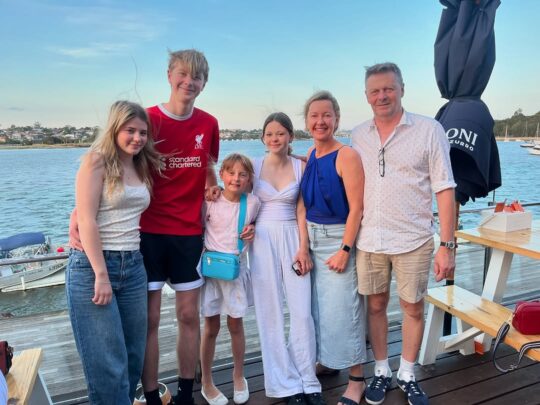
Away from the newsroom, Knight is a mother of three. Balancing irregular hours with parenting responsibilities has required flexibility – and humour.
“I’ve got a very patient husband. You just roll with the punches.”
A changing media landscape
Over three decades, she has watched political coverage grow more polarised.
“People exist in silos through social media. We’ve lost the ability to disagree politely,” Knight said matter-of-factly.
“People only really follow people who have the same views as them. And it becomes a real lightning rod, I think, if someone has a view contrary to yours, they’re considered the enemy in many ways. And I think that’s, that’s quite sad.
“It can be really volatile, really direct, and we’re seeing that played out in politics as well, with death threats being issued, and I think from a safety point of view, it’s concerning. And for people in the media, women in particular can cop a lot of very sexualized comments, which is just really disgusting.
“It’s much more pointed attacks, which is something that I hope calms down into the future.”
For her, public scrutiny can be harsh, but she remains pragmatic.
“You have to have a thick skin… people forget we’re people at the end of the day.”
Journalism with heart
Asked how she hopes to be remembered, Knight returns to core values instilled in her right back in her formative Coffs Harbour days.
“I just hope I’ve been fair in the way I’ve told people’s stories,” she says.
She has used her platform to speak openly about personal health challenges, believing visibility can save lives.
“We should be using the platform we have to help educate others, [but] it’s important to never lose sight of having heart in journalism.”
From a regional newsroom cadet to an international correspondent within sight of the Pentagon on September 11, Deborah Knight’s career has traced the changing contours of Australian media.
Her guiding instinct remains the same as when she was a teenager writing letters to the editor: curiosity about people, and a desire to tell their stories.
“I’m really proud to still be working in the game.”
And after decades at the microphone and behind the news desk, Knight continues to do what she has always done – listen, question, and bear witness as history unfolds.





 Proudly Australian owned and operated
Comments 0
Join the conversation. Comments are reviewed before they appear.
Be the first to comment.
Join the conversation
Tell us who you are to post a comment. We'll remember you next time.