


By Abby Sewell
A group of Australian women and children who left a camp in Syria that houses people with alleged ties to Islamic State are stuck in the country because Australian authorities have refused to allow their return, Syrian officials say.
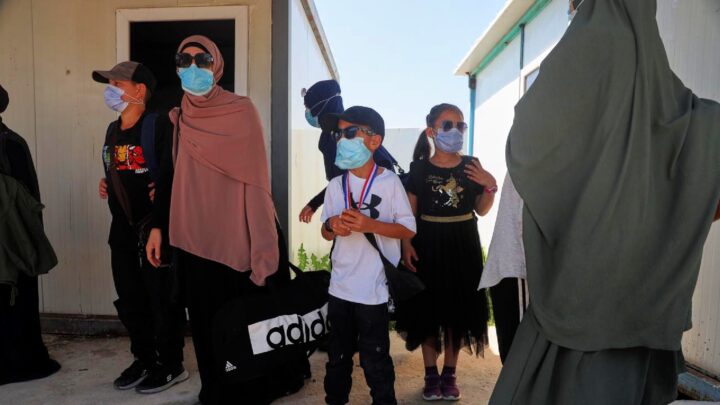
Thirteen women and children from four families last week left Roj camp, a remote facility near the border with Iraq that houses relatives of suspected militants, on Friday and travelled to Syria’s capital.
An official at the camp at the time said the families were expected to remain in Damascus for 72 hours and then be sent to Australia.
In response to an Associated Press inquiry about their status, Syria’s information ministry said after the families left the camp, the foreign ministry was informed that “the Australian government had refused to receive them”.
They were turned back from reaching Damascus International Airport, the information ministry’s statement said.
“These families are still awaiting a solution, which can only be achieved through co-ordination with the relevant international parties.”
Prime Minister Anthony Albanese said on Wednesday that “we are providing no support for repatriation and no assistance for these people”.
Syria’s information ministry said the families, through a lawyer, had obtained passports that were delivered by an “individual” that it did not identify while they were still in northeastern Syria in an area under the control of the Kurdish-led Syrian Democratic Forces, or SDF.
A Lebanese-Australian doctor, Jamal Rifi, previously told Australian media that he was helping to co-ordinate the repatriation effort.
Rifi could not be reached for comment.
A previous attempt to return 34 women and children to Australia from the camp in February was turned back by Syrian authorities.
Former IS fighters from multiple countries, along with their wives and children, were held in a network of camps and detention centres in northeast Syria after the militant group lost control of its territory in Syria in 2019.
Though defeated, the group still has sleeper cells that carry out deadly attacks in Syria and Iraq.
Australian governments have repatriated Australian women and children from Syrian detention camps on two occasions.
Other Australians have also returned without government assistance.





 Proudly Australian owned and operated
Comments 0
Join the conversation. Comments are reviewed before they appear.
Be the first to comment.
Join the conversation
Tell us who you are to post a comment. We'll remember you next time.