
106,977 are waiting for aged care, so where did the money go?


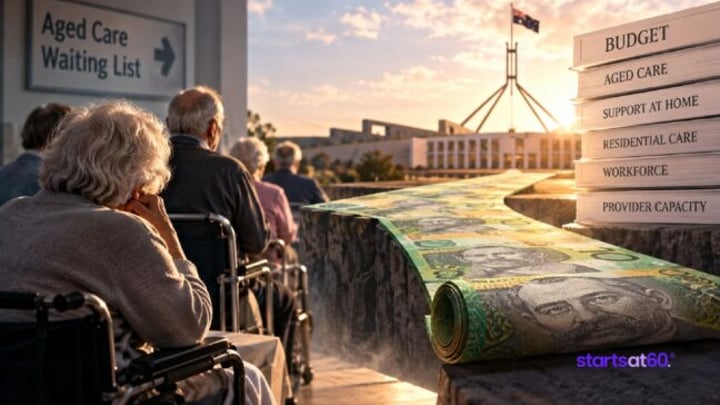
EDITOR’S VIEW
Yesterday, among all the billions and budget-speak surrounding the Federal Government’s final accounts for 2025–26, one detail deserved a lot more attention.
The government spent less than expected on aged care.
The ABC reported that Treasurer Jim Chalmers had announced a final budget deficit $6 billion better than forecast in May. Government receipts were $4.6 billion higher than expected and payments $1.4 billion lower.
Finance Minister Katy Gallagher identified aged care, childcare, the Pharmaceutical Benefits Scheme and some national partnership payments among the areas where spending came in below forecast.
So who’s bullshitting who here?
Because older Australians keep being told the aged-care system is under enormous pressure, families are waiting for help, hospitals are struggling with patients who are medically ready to leave but can’t always access appropriate care, and providers have been warning about workforce and capacity pressures.
Yet aged care was among the areas where spending came in lower than forecast.
What we do now
An underspend is not automatically a cut. Budgets are forecasts, actual spending comes in above or below estimates for all sorts of reasons, from lower demand and delayed programs to claims arriving later than expected.
So I’m not suggesting the government simply took money away from aged care, but on behalf of our Starts at 60 tribe I do want to know why spending came in below expectations, because demand for care isn’t exactly difficult to find.
As at June 30, 106,977 Australians who had been approved for ongoing Support at Home funding were still waiting for a place.
For people given a standard priority, the government’s own My Aged Care website put the estimated wait at seven to eight months. Even those assessed at medium priority faced an estimated five to six months.
That’s worth repeating in case it hasn’t sunk in… more than 100,000 people had been approved for ongoing home care and were waiting for it.
Against that backdrop, being told aged care contributed to lower-than-forecast government spending deserves an explanation.
So where did the money go?
There may be perfectly reasonable answers and I hope there are.
Maybe providers simply didn’t have the workforce or capacity to deliver the care that had been funded. Perhaps programs ran late, claims hadn’t landed or demand in some areas was lower than Treasury expected. There could be a perfectly mundane explanation.
We don’t know. And that’s precisely the problem.
What was the actual underspend in aged care? Which programs were responsible? How much related to Support at Home and how much to residential care or other programs?
Then there’s another important question: what happens to money that was expected to be spent on aged care but wasn’t?
Does it remain available for aged care? Does some roll into this financial year? Is it reallocated elsewhere? Or does the lower expenditure simply form part of the improved budget bottom line?
These aren’t gotcha questions, they’re very basic ones.
Announcing billions is the easy part
There is no shortage of big numbers attached to aged care. In May, the government announced another $1.4 billion over four years to improve affordability and access to home care, including $1 billion to fully fund personal care services.
It also committed hundreds of millions of dollars towards increasing residential aged-care capacity.
That’s substantial money, but there’s a big difference between putting funding into a Budget paper and getting care through someone’s front door.
Families don’t experience aged care in billions of dollars.
They know it in much simpler terms. Did someone turn up to help Mum shower on Tuesday morning? Has Dad finally received the equipment he needs to remain safely at home? Can an exhausted husband caring for his wife get some respite? And when an older Australian is ready to leave hospital, is there somewhere appropriate for them to go?
That’s where all those billions eventually have to mean something.
We want some answers
The government’s Final Budget Outcome was only released yesterday. There may well be a straightforward explanation for the lower-than-forecast spending.
If there is, good. Let’s hear it.
Starts at 60 will be asking the Federal Government exactly how much aged-care expenditure came in below forecast, which programs were affected and why.
We also want to know what happens to money that wasn’t spent and how the result squares with 106,977 Australians waiting for ongoing Support at Home funding at the end of the financial year.
Older Australians have heard plenty about how much money is being committed to aged care.
It’s fair to ask how much of it is reaching them.
What are your thoughts? Let us know in the comments.





 Proudly Australian owned and operated
Comments 26
Join the conversation. Comments are reviewed before they appear.
I'm 81 years old and living at home in Northern Rivers, NSW on my own. I have no issues other than I'm not able to clean my house (physically) anymore (due to arthritis lower back pain) or upkeep my garden...mowing, weeding, etc.
I was approved for Age Care 3 years ago and then informed that all the services I'd requested had waiting lists...and the waiting lists were all full.
Sooo, I applied for another assessment at a higher level and was interviewed and accepted at the beginning of September 2026. All I require is a bi-weekly cleaning and garden maintenance. It's now been a month and I'm still waiting for a referral list of people who can do these jobs.
And; “We don’t want to be told the government will “take it on notice”; which is their usual way of evading a question.
I’ve been waiting two years for an OT assessment to get a railings installed as a priority, there are no OT’s in my area, a main regional city, I did get my fortnightly cleaning approved and started.
2 areas that affect our household are
My husband has a Commonwealth support package that has no providers available to help as councils are being overwhelmed by the system and cannot supply help ( not even meals on wheels)so therefore no money spent on this package and good savings for government…
My support at home package is level 5 but $3,000 sent back to government every quarter as I cannot afford the percentages that is my contribution ($513 towards a walker and chair when I still had $3,000 funding for equipment in my package unspent ) so cannot use my package as intended…
We are both pensioners and the government are tricking us into thinking they are doing a good thing …
Long wait times for a package then 10 months after approval for funding to come through…. The whole thing is a joke…
Forcing families to care for elderly relatives is a much cheaper (for the government) solution to the age care crisis. The question is also , how much money "is" being put towards caring for the elderly. is this just another propaganda parade?? I worked in age care 40 years ago, seems not much has improved.
Probably waiting for us to die so that they can sit back and enjoy the money they have saved. Shocking treatment of the elderly who have worked hard all their lives and deserve better care.
They built this country, they're not migrants and they have no ongoing financial benefit to the taxation system, they can wait, we will get their votes anyway.
I really look forward to hearing how you go getting answers to those questions! It all seems to be smoke and mirrors; politicians and bureaucrats playing fast and loose with those most vulnerable - the 'easy' targets.
My husband just had a fall and was on crutches where I had to shower, dress, fix all meals, whilst I was getting over vertigo issues. We told aged care we were high risk, needed home support, meals, plus assistance to get to medical appts, where were AGED CARE?? F--K K--WS - STILL WAITING.
We need to know what's happened to that money, it is after all tax payer money which means it's our money and now it's missing, unbelievable!!!
I am female, 68 and live alone with no family close by. I was approved a year ago for a cleaner and cheap meals, in 4 months, it will be 2 years from when my Oncologist told me that my goal was to live 2 years.
No cleaner has been given to me that turns up. I rang to ask what was happening and was told by MyAgedCare that I had to find one myself because the 2 they chose said no, they are all busy with NDIS (better pay).
When they finally send a cleaner they can scrape my dead body off the floor if they can find it in the dust.
The system is broken. Worked and paid tax since I was 15. Thanks for nothing!
I am receiving Support at Home funding after 11months and 2 weeks on the initial waitlist. However, I have been waiting since March for my application for Assistive Technology funding to be assessed (reachers, walking sticks, splints, liftchair, grooming and dressing aids). These items have been assesed and prescribed and the appropriate applications submitted. These items are needed to help keep me safe at home. When I have contacted MyAgedCare on occassion, I have been told the wait for the appliacion to be looked at is 4-5 months, then after 4 months I was called and told my application was progressing and it would be a few more months to wait. I was also told there were thousands of people waiting like me and people were buying equipment themselves, but there is no reimbursement on items purchased before the approval is given by my aged care. I have postponed surgery and had 3 falls while waiting to have the small amount of equipment approved. Very frustrated with the new system.
I am very sad for older people waiting for any sort of aged care. The government won't help! It will raise your hopes with false promises which never come to fruition! It's services in place that are important not bullshit promises. Let's have another Royal Commission, that's a good way of diverting attention away from the problem. I know where the money is wasted: it's spent on Commonwealth bureaucracy to make sure that money is delayed or not spent on service to older people in need. Shame on you Mr Albonese and your government! May God forgive you 🙏
Ive done this already
There seems to be plenty of assessors but nobody on the front line to do any work. Aged care was never a priority old people are to close to death to be of any consequence to any polly and the vote they need.
There are 23 providers for the Commonwealth Home Support Program in Brisbane North. and they have no availabilities for domestic assistance. When asked most they say they are waiting on funding. They don't have a waiting list. Your told to keep phoning but expect it to be months before any availabilities.
no
Yes I want to know the answer to this question too. Where did the money go? Please publish the government’s response to this question. I’m keen to know. Thank you for bringing this critical information to the public.
We have been re-assessed, but have been told the funding will be available in November. We already pay someone to mow the grass and someone to garden. Why can’t they be reimbursed from our funding. They don’t want to work for the providers, because the providers make money and pay the workers the minimum wage , they also like the freedom to choose their clients.
We have been re-assessed, originally we were assessed in 2018 to have 2 hours of housework once a month, but we were also told it would be 4 years before it would be available, we asked to be assessed again early this year and were told they had run out of money, we have been reassessed but the funding won’t be a available until November. We already pay someone to mow our grass, why can’t they be reimbursed from our funding, seeing as the providers can’t supply anyone?
Given the shortfall of funds trickling through to Aged Care and that this was the reason cited to reduce the private health insurance rebate to older Australians, we should therefore assume the cut to the rebate is not warranted??? How do these decisions get made and justified within Government???
My first thought on reading through all these comments was "well, It's not just me and where I live". I am 81, and was first assessed about 3 years ago, was told you need home help for cleaning, meals, etc. Absolutely nothing, general reply was "no funding" so I continued to struggle and did it myself. I have just been re-assessed and approved for assistance and what do I find "sorry, no funding", but the care agencies still have huge staffs and garner heaps of funding for wages, expenses, etc. but there is nothing for the people who need it. I contacted one well known aged care provider and was very rudely told "there's no funding for that". The situation is disgusting, and the Government treats us as if we shouldn't exist any more, the situation needs to change. Perhaps the huge number of unemployed sitting on their backsides doing nothing could be employed to assist the elderly to earn their dole money.
I hope these comments are being passed on to the aged care minister... Always seems they disappear under a rock when it's too difficult for them. I truly believe they are out of their depth and just want to push their ideology... Not govern FOR the wellbeing of Australians...
I am horrified reading these comments. I am 81 and fortunately in fairly good health managing on my own. Now very concerned that when I can't manage I won't be able to get help.
The My Aged Care Website and your story seem to quote 9 months wait for funding unfortunately in North Queensland that is B S. I waited nearly 12 months to be assessed & at that point I was told by the assessor that I would have at least another 15 months to wait for funding. I am 85 years old & I believe that Dr. Jim and his PM mate Albo do not have a clue on how to handle money. Thank you for your story highlighting the question what did they spend the alleged savings on when they took the funds from aged care? Peter Millar
Perhaps take this to the ABC and Four Corners. They've done a couple of exposes on the failed Aged Care System - the more people who scream about this the more likely the government will be forced into action. This government has no clue - the Aged Care Minister is not yet out of nappies and cannot lie straight if he tried and Labour just cannot manage money. You watch the frantic backpedalling before the next election - I just hope Australians remember!
Migrants coming into the country in planeloads and we are building multistorey places everywhere!!
I must admit in my whole area North of Adelaide I have not heard of any Nursing Homes being built or Retirement Villages. Maybe thats now where the money is to be made!!
Join the conversation
Tell us who you are to post a comment. We'll remember you next time.