
Netflix is casting doubt on an iconic Vietnam image


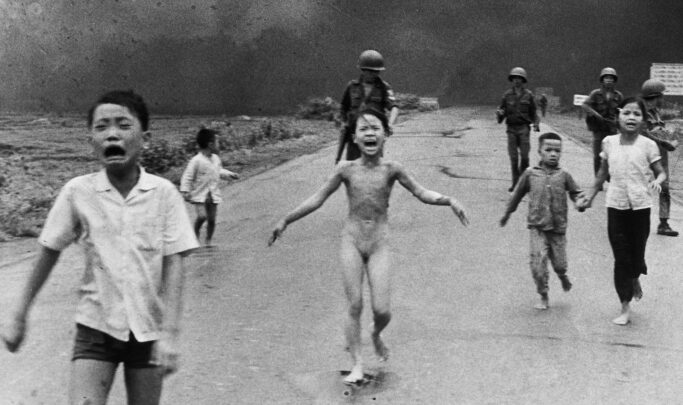
It’s one of the most powerful, enduring images of the Vietnam War.
But now, the authorship of ‘The Terror of War’ – widely known as ‘Napalm Girl’ – has been thrown into dispute by a new documentary, prompting investigations by major media and photography institutions.
Taken on 8 June 1972, the photograph shows nine-year-old Kim Phuc running toward the camera, screaming in pain after a napalm attack on her village. For more than 50 years, the image has been credited to Nick Ut, then a 21-year-old photographer working for the Associated Press (AP) in Saigon, now known as Ho Chi Minh City.
The photograph became one of the defining images of the war, earning Ut the Pulitzer Prize and World Press Photo of the Year in 1973, and later the US National Medal of Arts. Ut’s account that he photographed Phuc and then rushed her to hospital – has long been central to the image’s legacy.
That narrative is now being challenged in ‘The Stringer’, a new documentary recently released on Netflix and directed by Bao Nguyen. Narrated by photojournalist Gary Knight, the film claims the photograph was actually taken by a local freelance photographer, or “stringer”, who was paid US$20 by the AP and later written out of the historical record.
The documentary argues the true photographer was Nguyen Thanh Nghe, a Vietnamese freelancer. Central to the film’s claims is testimony from Carl Robinson, the AP’s photo editor in Vietnam at the time. Robinson alleges that after the film was developed, the AP’s Saigon bureau chief ordered the credit changed to Ut, ensuring the image remained AP property.
The filmmakers also cite forensic analysis by French investigative firm Index, which reconstructed the scene using aerial photographs, video footage and satellite imagery. Through 3D modelling, Index concluded that Ut was not in position to take the photograph and was standing about 75 metres away 15 seconds after the image was captured. The firm found Ut’s authorship “highly unlikely” and said the established account “doesn’t really make sense”.
Nguyen Thanh Nghe, interviewed in the documentary, states that “Nick Ut came with me on that assignment, but he didn’t take that photo. That photo was mine.”
After 53 years credited with taking the image, Ut declined to be interviewed for the film but described the allegation as “a slap in the face” via a Facebook post.
Following the documentary’s premiere at the Sundance Film Festival earlier this year, both the Associated Press and World Press Photo launched formal investigations. In May, World Press Photo announced it had suspended attribution of the photograph to Ut, stating that “based on analysis of location, distance, and the camera used on that day, photographers Nguyen Thanh Nghe or Huynh Cong Phuc may have been better positioned to take the photograph than Nick Ut”.
The organisation added: “Importantly, the photograph itself remains undisputed, and the award for this significant photo remains a fact. Only the authorship is suspended and under review. This remains contested history, and it is possible that the author of the photograph will never be fully confirmed.”
At the same time, the AP released a 97-page report concluding there is no definitive evidence that Ut did not take the photograph and said it would retain the attribution to him. However, the report acknowledged “unanswered questions” and said the agency “remains open to the possibility” that Ut was not the photographer.
The image continues to be distributed by the AP under Ut’s name, while World Press Photo now lists the author as “indeterminate/unknown”.
The controversy has renewed debate about authorship and attribution at a time when generative artificial intelligence has made doubts about originality and credit a more urgent issue. The filmmakers argue that power dynamics, rather than perspective, often shape the official historical record, concluding that “even the most entrenched histories deserve to be reexamined.”





 Proudly Australian owned and operated
Comments 0
Join the conversation. Comments are reviewed before they appear.
Be the first to comment.
Join the conversation
Tell us who you are to post a comment. We'll remember you next time.