
Pet insurance or rainy-day fund: Which really leaves you better off?


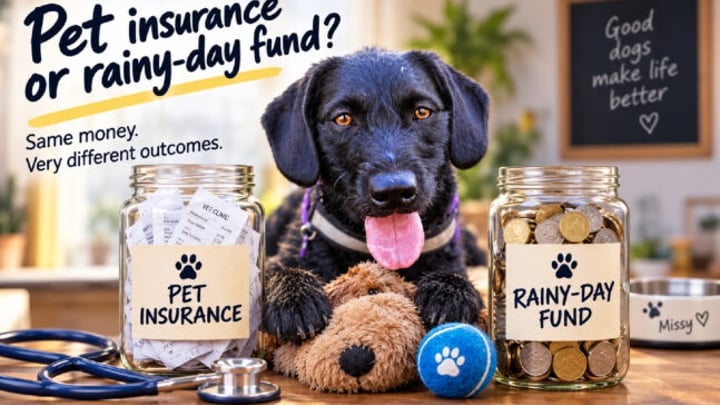
Our Labradoodle Missy is two years old and, by my reckoning, has already made three reasonably determined attempts to kill herself.
Number one: a large block of chocolate swiped from the table.
Number two: two entire packets of chewing gum in one sitting.
Number three, and by some margin her finest effort: getting into a bait station chockers with rat poison.
Fortunately, Missy survived all three adventures, along with the usual vet visits that come with owning a young dog.
We also pay $83.61 a month for pet insurance, which is $1,003.32 a year. If, purely for the sake of simple maths, that premium never increased, we’d pay $10,033.20 over a decade.
Which raises a question I’ve heard plenty of pet owners ask: would we be better off putting that $83.61 into a separate bank account every month and simply paying the vet ourselves?
Maybe.
If Missy enjoys a long, healthy life without a major accident or illness, we might eventually look back at all those premiums and conclude we’d have been financially better off doing exactly that.
But Missy has already demonstrated the flaw in the theory and you don’t get to choose when the expensive thing happens.
One in four owners is already delaying care
New research suggests millions of Australians are struggling to afford veterinary treatment.
A Finder survey of 602 Australian pet owners found one in four — 25 per cent — admitted delaying veterinary treatment for financial reasons.
Finder estimates that equates to about 1.9 million Australians.
For anyone whose dog or cat is part of the family — and particularly older Australians whose pet may be an enormously important source of companionship — it’s about what happens when emotion collides with the household budget.
You know what you want to do for your pet but the question is whether you can afford to do it.
So does pet insurance actually stack up?
Finder says the average pet insurance premium in Australia is around $1,200 a year for dogs and $600 for cats.
Take that $1,200 dog premium, over 10 years, that’s $12,000.
It’s easy to understand why an owner might think: forget the insurance company. I’ll put $100 into a dedicated savings account every month instead.
So let’s test the theory with three hypothetical dogs.
These aren’t actual insurance claims or predictions, they’re simply illustrations of how differently the numbers can play out.
Scenario one: The dream run
Your dog enjoys a remarkably healthy decade.
Apart from routine care, there are a couple of unexpected vet visits costing $2,000 in total. At a hypothetical constant premium of $1,200 a year, you’ve paid $12,000 in insurance premiums over those 10 years.
Had you instead put $100 a month into a dedicated pet account, you would also have contributed $12,000. Pay the $2,000 in unexpected bills and $10,000 of those contributions remains.
On those simplified numbers, banking the premium yourself wins easily.
Scenario two: A few expensive years
This time your dog has several unexpected health problems over the decade, resulting in $8,000 in vet bills.
Again, our hypothetical premiums total $12,000.
The self-funding owner has put $12,000 aside, paid the $8,000 and has $4,000 of those contributions remaining.
It might still appear that self-funding has come out ahead.
But insurance isn’t as simple as paying a premium and having every vet bill paid in full. Policies can include excesses, reimbursement percentages, annual limits, exclusions and sub-limits for particular treatments.
Whether insurance leaves you ahead or behind depends heavily on what happens to your pet and what your policy covers.
Scenario three: The nightmare bill
Now change one thing.
Instead of the big expense arriving after you’ve spent 10 years building your pet emergency fund, it arrives in year three.
Finder says some veterinary surgeries can exceed $20,000.
Our self-funding owner putting aside $100 a month has accumulated just $3,600.
Then comes a $20,000 emergency.
Suddenly there’s a $16,400 gap to find.
An insured owner could potentially have a significant proportion of an eligible bill reimbursed, depending on the policy, excess, reimbursement rate, limits and exclusions, and suddenly the calculation looks very different.
You’re not really insuring against the average year
Looking back after a healthy decade and adding up every dollar paid in premiums is one way to judge insurance.
But it misses much of what you’re buying. Insurance is protection against the terrible year you hope never arrives.
Maybe the more useful question isn’t: “Will I claim back more than I pay?”
It’s this:
If my pet needed $10,000 or $20,000 worth of treatment tomorrow, could I comfortably pay for it?
Some people can.
For them, putting the equivalent of an insurance premium into a dedicated emergency account may make sense, provided they actually save the money and understand the risk they’re retaining, but plenty can’t, and the latest figures suggest that when those bills arrive, some Australians are already making decisions they’d rather never have to make.
When money gets between you and your pet
Finder insurance expert Ceyda Erem said rising veterinary costs were leaving owners facing heartbreaking choices.
“Pets are often part of the family, but when money is tight, vet care can become an expense people simply can’t afford,” she said.
“No pet owner wants to delay treatment, yet millions are finding themselves forced to weigh up their bank balance against their pet’s health.”
There can be another sting in delaying treatment. According to Erem, something relatively minor may be easier and cheaper to treat when caught early. Waiting can allow a condition to deteriorate, potentially resulting in more complicated treatment, greater pain for the animal and a much larger bill.
Not all insurance is equal
Finder found a difference of more than $1,100 a year between the cheapest and most expensive pet insurance policies it analysed.
Owners need to look beyond the monthly premium at annual benefit limits, reimbursement rates, excesses and any sub-limits applying to particular conditions or treatments. Self-funding deserves the same scrutiny.
Saying you’ll put $80 or $100 aside every month is one thing, actually doing it for years — and leaving the money untouched when the washing machine dies or the car needs repairing — is another.
Even a disciplined saver faces the timing problem.
Your pet doesn’t know there is only $2,000 in the emergency account when it decides to eat the thing it absolutely shouldn’t have eaten.
Missy certainly doesn’t.
The insurance you hope you never need
We could pay thousands of dollars over Missy’s lifetime and ultimately discover we’d have been financially better off putting every premium into the bank.
If that happens, I’ll probably grumble about the money, but I’ll also have been incredibly lucky.
It will mean the dog we love didn’t suffer the accident, illness or emergency that made those premiums suddenly look worthwhile.
Three adventures into Missy’s short life, I’ve stopped thinking about her insurance purely in terms of whether we’ll eventually “get our money back”.
I hope we don’t.
What I want is to know that if there’s ever a fourth suicide attempt — and knowing Missy, I wouldn’t bet against it — the first question we ask is what the vet needs to do.
Not whether we can afford to let them do it.
The financial scenarios in this article are hypothetical and deliberately simplified for illustration. Actual pet insurance premiums can change over time and policies vary in coverage, exclusions, excesses, reimbursement rates, waiting periods and benefit limits. Routine care may not be covered. Readers should consider their own financial circumstances and individual policy terms.





 Proudly Australian owned and operated
Comments 3
Join the conversation. Comments are reviewed before they appear.
Bought a dog and immediately started pet insurance and. When she was about two years old she was bitten by a snake. Had to have three doses of anti-venom @ $1300.00 per dose and 24 hour vet care for four days, total bill $11,700.00. Was Pet Insurance worth it, YES!!
my labradoodle went to ghe emergency vet 6 times before he was 18 months old for eating things- not since - I've got better, but hes very clever at getting at food ge shouldn't. I'm keeping the pet insurance!
It would help if pet Insurance covered dental which is very expensive a d sadly a lot of people cannot afford minimum of $900 for cleaning let alone up to $3,000 for treatment
Join the conversation
Tell us who you are to post a comment. We'll remember you next time.