
Honey, I shrunk the chips: 16m Aussies spot supermarket sting


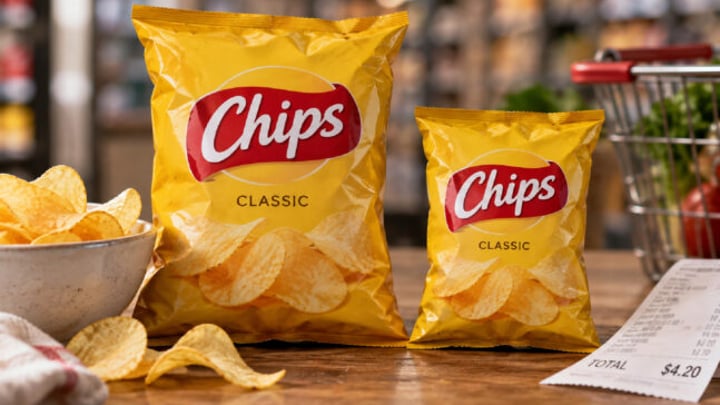
Ever picked up your usual packet of chips and thought it felt a bit lighter than it used to?
Or opened a block of chocolate and wondered where the rest of it went? Same with Wagon Wheels, pies and there’s no doubt ice-creams aren’t the same size as they used to be.
Plenty of Australians have noticed the same thing, with new research suggesting 16.1 million shoppers have spotted products getting smaller while the price stays the same.
It’s called “shrinkflation”, and according to a Finder survey, it has become difficult to miss.
Almost one in three respondents — 32 per cent — said they notice it on almost every grocery shop. Another 42 per cent said they had spotted it on particular products during the past year. Many shoppers have had enough.
Smaller pack? Shoppers are walking away
Two in five Australians surveyed said they had switched to another brand or a home-brand alternative after noticing a favourite product had shrunk.
More than one in five — 22 per cent — had stopped buying some products altogether.
Finder personal finance expert Sarah Megginson said shoppers were paying closer attention as household budgets came under pressure.
“Some brands are reducing the size, weight or quantity of items while leaving the price unchanged, which is a practice commonly known as ‘shrinkflation’,” she said.
“It’s a more subtle way for businesses to claw back rising costs, because most shoppers are watching the price tag, not the fine print on the label.
“In some cases, it’s even worse than that — the product gets smaller and the price goes up at the same time.”
Shrinkflation is not necessarily illegal. The ACCC describes it as reducing the size of a grocery product while the price stays the same or increases.
For shoppers, however, the result is straightforward: you can end up paying more for every gram or millilitre without the price on the shelf appearing to change.
Check the small print
The easiest way to catch it is to ignore the packet price for a moment and look at the unit price.
That’s the smaller figure on supermarket shelf labels showing what you’re paying per 100g, kilogram, 100ml, litre or other standard measurement.
“The best defence against shrinkflation is checking the unit price, not just the shelf price,” Megginson said.
“Comparing the cost per 100g or 100ml lets you see exactly what you’re paying for a product, rather than being guided by a familiar box or a price you remember from last time.”
The ACCC also recommends unit pricing when comparing brands, packet sizes and specials.
It’s particularly worth checking when something is advertised as being on special. A familiar brand with a big discount sticker may still cost more per 100g than the packet sitting beside it.
And bigger doesn’t always mean better value. Finder suggests shoppers can also cut grocery costs by planning meals before shopping, comparing home brands, looking for marked-down fresh food later in the day and cooking enough to provide leftovers or meals for the freezer.
With almost three-quarters of Australians surveyed saying they have noticed shrinkflation, checking how much product you’re actually getting may now be just as important as checking the price.
Source: Finder Consumer Sentiment Tracker, survey of 1,010 Australian respondents, June 2026.





 Proudly Australian owned and operated
Comments 7
Join the conversation. Comments are reviewed before they appear.
Its not shrinkage, call it what it is, a rip off. only way to really fix it is to stop buying such products if most/everyone did maybe manufacturers would stop ripping customers off.
Also baked beans.
And crumpets, muffins. It is a shock almost every time I open a grocery item.
Checking unit prices is essential. Some of the so called ‘specials’ end up more expensive. Lots of sneaky tactics used by the manufacturers and the shops
An easy to test tis,,, go to Woolies soft isle and look at the price of Pepsi Max. Carton of 10 Cans, $10.00, 24 Cans, $34.99. 30 Cans, $29.99,, but sometimes on Special for $24.99. All cans were 375 ml. work that out!!!!!!!
This is inflation being disguised. The manufacturers costs have risen so to cover that they give you less for the same price. The ACCC won’t make a fuss about that because that does not appear as an inflated price on your grocery spend and thus does not make it to government inflation figures
Coles - Colgate Pro Relief toothpaste initial "sale price" 1 month ago was $5.50.
This week Coles advertise the "sale price" as $7.70!
'Greed is good' motto for Coles and Woolies.
Unfortunately Aldi imports a lot of products from China!
Join the conversation
Tell us who you are to post a comment. We'll remember you next time.