
Your old mattresses can now be recycled into insulation


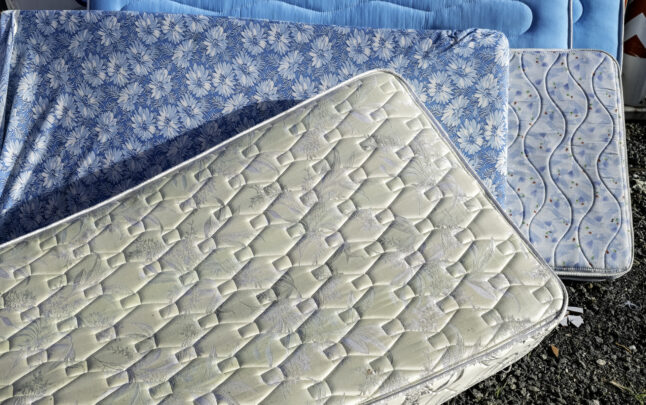
Researchers at Swinburne University of Technology have developed a method to recycle unwanted mattresses into sustainable building insulation materials using fungi.
The team’s findings, published in the Nature’s Scientific Reports journal, detail how a common fungus was grown together with shredded mattress foam to produce a solid, lightweight material.
Mattresses are among the most difficult household items to recycle due to their size, durability and complex composition, according to Swinburne authors Dr Hong Phong (Peter) Nguyen, Associate Professor Mostafa Nikzad and Dr Huseyin Sumer.
“Mattresses are durable, bulky, and often end up in landfill,” says Swinburne engineering expert, Dr Hong Phong (Peter) Nguyen.
“Through natural biological processes, we can give this waste a second life.”
The process involves fungal roots binding with foam waste and forming natural mineral compounds that can withstand extreme heat. Researchers say the material remained stable when exposed to temperatures close to 1,000°C.
“The material performed well as an insulator, with heat-blocking ability very close to commercial insulation products already used in homes and buildings,” says Dr Nguyen.
“The approach is both practical and environmentally responsible, using fungus that is closely related to strains used in food production and medicine, and relying on common, widely used chemicals.”
The research was co-funded by the Australian Bedding Stewardship Council. Director of Innovation Tracey Pryor says about 1.8 million mattresses are disposed of each year in Australia.
“740,000 mattresses are still sent to landfill, equating to approximately 22,000 tonnes of needless waste that can take up to 120 years each to decompose,” Pryor says.
Researchers say the fungus-based material could have broader construction applications with further development, including fire-resistant insulation, building panels and components shaped for emerging construction techniques such as 3D-printed building elements.
“Our work shows how combining biology with waste materials, while leveraging deep manufacturing science, can lead to smart, low-impact solutions that better the environment and the lives of everyone.”





 Proudly Australian owned and operated
Comments 0
Join the conversation. Comments are reviewed before they appear.
Be the first to comment.
Join the conversation
Tell us who you are to post a comment. We'll remember you next time.