
Handy photo shows exactly how dating scammers target victims


While most people who use online dating websites are there for legitimate reasons, there are also those who use it as an opportunity for fraud.
Online dating scams are rife around the world and females, particularly those over the age of 60, are twice as likely to lose money to fraudsters than men. While men send money to scammers less often, they tend to give approximately 20 per cent more.
Thankfully, most scams are easy to avoid once you know what to look for.
ID care have provided a handy ‘dating scam map’, based on their analysis of over 300 scam cases reported from 2014 to 2018, on how dating scammers target victims.
Typically, the scammer will first create a fake online profile to lure in victims. Dating scams often take place through online dating sites, but scammers may also use social media — 35.7 per cent of victims and scammers meet on Facebook. The victim never sees the love interest face to face and most communication happens via Facebook Messenger, Whats App or Viber.
ID care reports, 46.4 per cent of scammers prefer email as a secondary form of communication as it’s easier to use Google Translate and spellcheck to edit their messages.
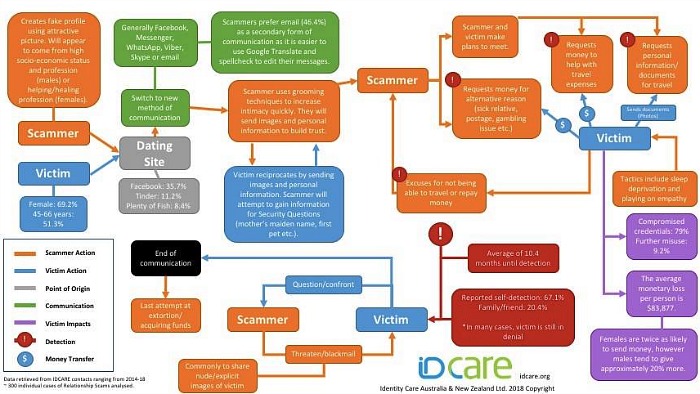
There are specific warning signs to look out for including “grooming techniques”, which the scammer uses in the hopes of gaining private information, such as security questions for passwords, which most people set to their mother’s maiden name, the street they grew up on, and their pet’s name, among others.
Don’t be fooled by photos or personal information the person on the other side of the screen sends either, as ID care explains “they will send images and personal information to build trust” but they’re often fake photos ripped from someone ease’s profile.
ID care found that once the scammer and victim plan to meet, the scammer will either request money for travel expenses or for alternative reasons, such as a sick relative.
The scammer will then continue to use specific and highly validating narrative to gently groom the victim into a “loved-up” state so powerful, that the victim will agree to sends funds across.
“Motivation to send money is high because the victim wants to meet their love interest and continue to build the envisioned future together,” ID care said.
The scammer will then make up an excuse for not being able to travel or repay the money. At this point either the victim or a close friend or family member usually realises they’re being scammed, however in many cases the victim is still in denial.
According to ID care, relationship scams cost Australians and New Zealanders, on average, $83,977 per event, and it often takes victims 10.4 months to detect the scam. For many, realising they’d been duped resulted in emotional and mental health issues.
So how can you protect yourself? The Australian Competition Consumer Commission (ACCC) says you should never send money to someone you haven’t met in person, to always consider the possibility that the approach may be a scam, to be alert to things like inconsistencies in their back story and to be cautious when sharing personal pictures or videos.





 Proudly Australian owned and operated
Comments 0
Join the conversation. Comments are reviewed before they appear.
Be the first to comment.
Join the conversation
Tell us who you are to post a comment. We'll remember you next time.