


By Andrew Stafford
When he was a little boy, Aboriginal people weren’t allowed in town so Don Rowlands lived on the banks of the Diamantina River.
Sometimes at night he’d see ghostly white figures creeping through the camp outside Birdsville, in the border country of far west Queensland.
He soon worked out what was going on.
One night, a police officer was walking through the encampment with a torch when a naked whitefella shot out of one the humpies.
“Stop, in the name of the king!” the officer shouted.
“F*** the king,” the man replied as he fled into the shrublands, shirt and trousers under his arm.
“As Aboriginal people, we just accepted that. There was nothing we could do about it,” Mr Rowlands tells AAP.
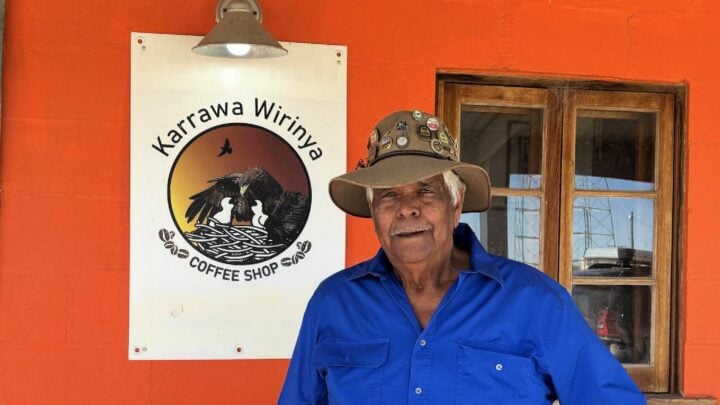
Now 78 – he looks 20 years younger, with bright eyes and a white pencil moustache – Mr Rowlands and his wife Lyn are part of the town glue.
While Lyn runs the Karrawa Wirinya coffee shop, Mr Rowlands is set to hang up his ranger’s hat after 33 years looking after Queensland’s largest national park.
Formerly known as the Simpson Desert National Park, Munga-Thirri is a vast wilderness of sand dunes, gibber and salt pans.
The country is bursting with life after heavy summer rains closed the Birdsville Track in South Australia for months.
Along with high fuel prices, it’s made life hard going for people travelling to the Birdsville Races, an iconic outback horse racing meet held every September that swells the town by 7000 people.
Campers, caravans and tents stretch as far as the eye can see either side of the river where Mr Rowlands grew up.
He watches people come and go with good humour and grace.
“I don’t know if I’d be sitting here today, in this happy, happy place, had it not been for the job,” he says.
Looking after Munga-Thirri, the traditional home of the Wangkangurru Yarluyandi people, has been Mr Rowland’s life.
Growing up, “if you mouthed off too much, you wouldn’t get a job, or your job would dry up, so you learned just to zip it,” he says.
Being appointed as ranger of Munga-Thirri changed all that.
He says it gave him the opportunity to stand up and speak for himself, his people and his country.
“I was the first ranger [the Queensland government] employed here, plus it was my traditional lands,” he says.
He also helped convince the Diamantina Shire Council to rename the national park according to its traditional title of Munga-Thirri.
Early on, it was hard to find the songlines of his people. He hadn’t been given the opportunity to search for himself.
As he grew to know his own country better, he found old campsites, burial grounds and native wells.
He worries for younger Traditional Owners, who he says are over-reliant on GPS navigation.
“For people trying to become part of the landscape, they’ve got to leave that alone until they learn the country, in their mind, in their heart,” he says.
The job must fall to someone else now. Rowland isn’t quite as fit as he once was, his reflexes aren’t as sharp, and a fall in the desert could be fatal.
“It’s been such a good job, and it’s really hard to leave, but I can’t keep going,” he says.
But he’s left his country in better shape than he found it, and his mind is still sharp.
“I don’t think I’m a radical,” he says.
“I never wanted to be, I knew that I had to tell the truth of my family and who I am, and where I am. It’s been a good life.”





 Proudly Australian owned and operated
Comments 0
Join the conversation. Comments are reviewed before they appear.
Be the first to comment.
Join the conversation
Tell us who you are to post a comment. We'll remember you next time.