
John Edward: Why Humanity’s Biggest Challenge Isn’t AI — It’s Apathy



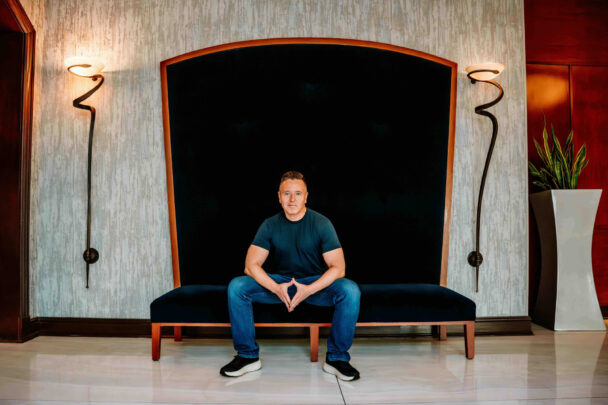
When I first interviewed John Edward for my book Conversations With Mediums more than 13 years ago, the world looked very different.
Artificial intelligence was largely confined to science fiction, social media was still in its relative infancy and conversations around mindfulness, consciousness and generational healing were far from mainstream.
Back then, Edward spoke of a coming shift in human consciousness.
Today, as the internationally renowned psychic medium, bestselling author and former host of Crossing Over with John Edward prepares to return to Australia for a national tour later this year, I wanted to revisit that conversation and ask a simple question.
Did the shift actually happen?
According to Edward, it did. The catch is that we’re still living through it.
The fever stage
“I think the shift is a slow shift,” Edward says.
He points to growing social division, political unrest and increasing awareness of long-ignored problems as evidence that something deeper is unfolding beneath the surface.
“A fever shows up as a symptom of an infection,” he points out. “It tells us something’s going on. I think we’re currently in that fever stage of the shift.”
Rather than viewing today’s turmoil as proof humanity is moving backwards, Edward believes it may be forcing people to confront issues they have spent generations ignoring.
“For some people it’s waking up politically,” he says. “For others it’s recognising family wounds and generational trauma. Events are taking place, and they’re giving us opportunities to use our free will and make changes.”
It’s a perspective that feels less mystical than practical. The shift, in his view, isn’t a dramatic spiritual event but a gradual awakening that asks people to take greater responsibility for themselves and the world around them.
AI doesn’t worry him
In an age where artificial intelligence dominates headlines and fuels fears about the future, Edward’s response is unexpectedly measured.
“I’m actually not worried about it, I think AI is going to be used as a tool.”
He sees enormous potential in medicine, diagnostics, legal research and pattern recognition, where technology can rapidly process information that would take humans significantly longer. The greater challenge, he believes, is remembering what makes us human.
“AI can prompt conversations about consciousness, but it still doesn’t have that emotional, soulful, lived-life component,” he explains.
While many fear machines becoming more intelligent, Edward is more interested in whether humans remain connected to their own experiences, emotions and relationships.
The real threat
Ask Edward what worries him most about humanity and his answer comes instantly.
“Apathy.”
Not war or technology. Not even misinformation.
Apathy.
He believes social media has created an illusion of participation where people often mistake posting for action.
“People are protesting online, but it’s not actually doing anything. You’re yelling into the void,” he says.
Edward argues that social platforms can be valuable tools for organising and educating, but only when they lead to meaningful action in the real world. Otherwise, they risk becoming “echo chambers where people become increasingly divided while believing they are making a difference”.
“It’s created an apathetic environment where people scream at each other and the algorithms simply feed them more of the same.”
Why sceptics matter
One aspect of our original conversation that has aged remarkably well was Edward’s view on sceptics. Many people might expect a psychic medium to dismiss doubters. Instead, he believes critical thinking has never been more important.
“Being a critical thinker and being able to discern what’s real and what isn’t is imperative now,” he says.
Edward points to the explosion of AI-generated content, voice cloning and online scams as evidence that people need to question far more than they once did. He regularly asks audiences how many have looked at a photo or video online recently and found themselves wondering whether it was genuine.
“A lot of hands go up,” he says. “Honestly, all of them should.”
The same principle applies to his own profession as these days, he says, anyone can create a social media profile, build a following and call themselves a psychic medium.
“There’s nothing to stop them, so the only thing I can do is arm people with information,” Edward says.
“If a medium is saying, ‘I’m the best’ or ‘I’m the only one doing it right’, that’s a problem. If they make it all about themselves, that’s not cool. And if you’re only getting nice, fluffy philosophy that makes you feel good but no factual validation, then people should be careful.”
For Edward, the role of a medium has never been to become the centre of attention.
“I always say the medium is just the printer,” he explains. “The printer doesn’t know anything. It only knows what’s been sent to it. The source is where the information comes from, and my job is simply to deliver it.
“What people should be getting are facts, validation and evidence. If all they’re getting are vague compliments and generalities, then they should absolutely be sceptical.”
Surrendering the ego
Perhaps the most revealing part of our conversation wasn’t about spirits at all.
It was about ego.
Edward believes some of the most gifted people he has encountered have ultimately become their own worst enemies, not because they lacked ability but because they started believing the work was about them.
“The minute someone makes the work about themselves, they’ve lost the plot,” he says.
He traces that lesson back to hearing Wayne Dyer speak about service, humility and the danger of seeking validation from others. More than 30 years later, Edward still returns to the same principle.
“We always have to be students of the universe,” he says. “The second you think you’ve got everything figured out is probably the second you stop growing. I’m only as good as my last reading and there are days when I get things wrong or wish I could have done better. That’s what keeps you humble. That’s what reminds you that there’s always more to learn.”
Age, grief and what matters
When we first spoke, both of us had young children.
Now they’re adults.
Edward is 56, turning 57, and says age hasn’t changed his understanding of life so much as deepened it.
“It’s like adding salt to food. It just makes everything taste better,” he says, laughing.
With both his own parents having died relatively young, he is acutely aware of wanting to be present for the next chapter of his family’s story.
“I want to be around,” he says. “I want to meet my grandkids. I want to see what happens.”
And after decades spent talking to people about loss, grief remains one of the most important lessons he has learned.
“It doesn’t just go away,” he says, and his analogy is simple.
“Grief is like body fat. It doesn’t disappear by itself. You can’t wish it away. You have to work at it.”
Then comes perhaps the most important message of all.
“You’ve got to feel it. If we feel it, and we deal with it, then healing can actually begin.”
John Edward returns to Australia in October and November for a national tour, with shows scheduled in Sydney, Canberra, the Gold Coast, Brisbane, Cairns, Adelaide, Hobart, Bendigo, Perth, Geelong, Newcastle and Melbourne. Tickets and tour information are available at johnedward.net





 Proudly Australian owned and operated
Comments 2
Join the conversation. Comments are reviewed before they appear.
Apathy is killing Australia, e.g. like that shown to politicians they are destroying Australia yet while people whinge they still continue to vote for these creatures. Protests don't work (not enough people get out there often enough -- what's the point why bother nothing is going to change is the chant I hear). Politicians won't change a system that works for them if it doesn't then they change it for themselves. Well may they say God save the King, for no one will save Australia from its politicians if the people don't.
Thank you, so agree. Also, Julie`s post below.
Join the conversation
Tell us who you are to post a comment. We'll remember you next time.