
Australia mulls military help for Iran-besieged allies


Australia could provide military aid to help protect allies in the Middle East against Iranian strikes as more citizens arrive home after being stranded in the region.
Foreign Minister Penny Wong has confirmed the government is weighing up whether to answer requests for help to countries hit in Iranian retaliatory actions.
But she has ruled out any Australian troops being involved in offensive operations during the US-Israeli attacks on the Islamic regime.
“Many countries which are non-participants have been attacked by Iran through this,” Senator Wong told ABC’s Insiders program on Sunday.
“You would anticipate, as a consequence, that we have been asked for assistance, and we will work through that carefully.”
“We are not participating in offensive actions against Iran and we’ve made clear we would not participate in any ground-troop deployment into Iran.”
The US and Israel launched strikes on Iran just over a week earlier, killing leader Ayatollah Ali Khamenei.
Iran’s retaliatory strikes have hit the United Arab Emirates, Qatar and Bahrain, among other countries.
Senator Wong said Australia’s military aid could help provide protection against Iranian drone and missile attacks.
“We have been asked and we will consider … if a decision is made, I’m sure that we will be transparent with the Australian people,” she said.
“This is not Iraq and we are not the Howard government. We are not asking Australians to accept men and women being deployed into a ground war.”
The foreign minister added any regime change in Iran should be directed by its citizens, putting her at odds with recent statements from US President Donald Trump, who said he should be involved in choosing the country’s leader.
“I think we all know that for there to be a sustainable change of regime, it has to be something that the people of that nation back and seek,” Senator Wong said.
Another 151 Australians arrived in Melbourne on a flight from Dubai on Sunday afternoon, one of three due to land in Australia during the day after UAE airspace was briefly closed due to renewed missile strikes.
One of those flights, to arrive in Perth about 5pm local time with 93 Australians on board, was previously cancelled.
As of Sunday morning, more than 1500 Australians had arrived home from Dubai.
Australians have also been bussed out of the Qatari capital Doha, the base for Virgin Australia’s partner Qatar Airways, to Saudi Arabia’s capital Riyadh.
Three buses carrying 92 citizens, permanent residents and their families have departed.
Assistant Foreign Minister Matt Thistlethwaite said commercial flights were still the best way for Australians to leave the region.
But he admitted the cost of some flights might be a factor in people not being able to return as some planes departed with large numbers of empty seats.
About 115,000 Australians were in the Middle East when the US and Israel launched strikes on Iran.
Australian Travel Industry Association chief executive Dean Long said flights leaving with empty seats should not be a concern.
“The good news is there’s not a huge number of people that we should consider stuck in the transit hub,” he said.
“The people that are primarily in the Middle East now are choosing to be in the Middle East because that’s where they live.”
Meanwhile, a surprise apology from Iran to its Middle Eastern neighbours has done little to calm tensions across the region, with critics condemning the move at home and the United States warning that military pressure could intensify.
Iranian President Masoud Pezeshkian delivered the message over the weekend, expressing regret to nearby Gulf nations after missile and drone strikes rattled parts of the region during the past week.
In a televised address, Pezeshkian said Tehran had no desire for a broader regional war and insisted Iran’s attacks were linked to the presence of US military bases in neighbouring countries. He suggested Iran would avoid further strikes against those nations – provided their territory was not used to launch attacks on Iran.
“We apologise to our neighbours for the anxiety created by recent events,” Pezeshkian said, adding that Iran “has no desire to expand this conflict beyond those who are attacking us”.
He argued that Iran’s actions had been driven largely by the presence of foreign military forces in neighbouring countries.
“If our neighbours’ territory is not used as a base for aggression against Iran, we have no reason to target them,” he said.
The tone of the apology surprised many observers, particularly as tensions remain high and missiles continue to be exchanged across parts of the Middle East.
For countries such as Saudi Arabia, Qatar and the United Arab Emirates, the message has been met with caution rather than relief. Several Gulf states have already been forced to intercept drones and missiles in recent days, and some governments have warned they will respond if their territory or infrastructure is targeted again.
The diplomatic gesture also sparked strong criticism inside Iran itself.
Hardline figures within the country’s political and military establishment have reportedly condemned the apology, arguing that it sends the wrong signal while the country remains under heavy military pressure.
Some officials have insisted Iran should continue striking targets linked to the United States and Israel, particularly in countries that host American military bases.
Another political commentator close to Iran’s hardline factions said the message risked undermining national unity.
“When the country is under attack, apologising to those who host foreign military bases is unacceptable,” he said.
Analysts say the debate reflects deeper divisions within Iran’s leadership over how the conflict should unfold.
While some leaders appear keen to limit the risk of a wider regional war, others believe backing down would only embolden their adversaries.
At the same time, the fighting has taken a heavy toll. Iranian officials say hundreds of civilians have been killed during recent strikes on military facilities and infrastructure across the country.
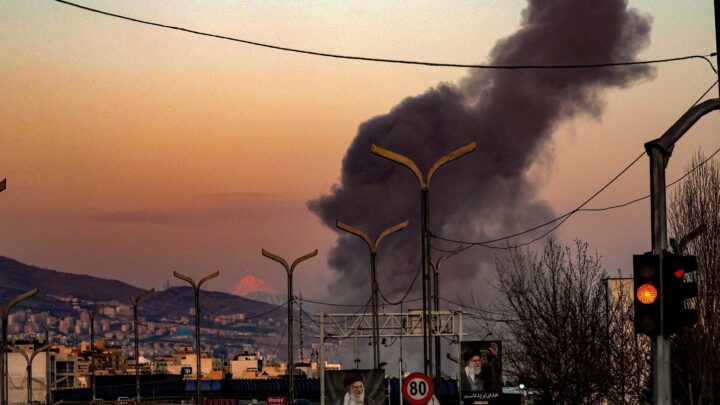
The United States and Israel have both launched waves of attacks targeting what they say are Iranian military sites and strategic assets. Explosions have been reported in several major cities, including Tehran, as the conflict continues to intensify.
In Washington, US President Donald Trump has responded to the apology with a warning that pressure on Iran will continue.
Posting on social media, Trump suggested the apology showed the military campaign was working.
“Iran knows what’s coming,” he wrote. “If they continue attacking our forces or our allies, they will be hit very hard.”
In another message, Trump warned that Iran could face devastating consequences if the conflict escalates further.
“They’re talking about apologies now because they understand the alternative is destruction and death,” he said.
He warned Iran could face even stronger military action in the coming days, declaring the country would be “hit very hard” if attacks continued against US forces or regional allies.
The tough rhetoric signals little appetite in Washington for any immediate de-escalation.
US officials have indicated that further strikes remain an option as the conflict enters a critical phase, raising fears that the situation could spiral into a broader regional confrontation.
Across the Middle East, governments are watching events closely.
Air defence systems have already been activated across several countries to intercept incoming missiles and drones, while military forces across the region remain on high alert.
Energy markets have also been rattled by the escalating crisis, particularly concerns that shipping routes through the Strait of Hormuz – one of the world’s most important oil transit corridors – could be disrupted if the conflict widens.
For now, Iran’s apology may signal that some leaders in Tehran are wary of the consequences of a wider war.
But with internal divisions growing, military strikes continuing and strong warnings coming from Washington, few analysts believe the situation will calm quickly.
In the Middle East, apologies can sometimes open the door to diplomacy.
But they can also arrive in the middle of a conflict that is still gathering momentum – and right now, the signs suggest the region may be heading toward a more dangerous phase rather than stepping back from the brink.





 Proudly Australian owned and operated