
Thinking about full-mouth dental implants? 7 questions worth asking first


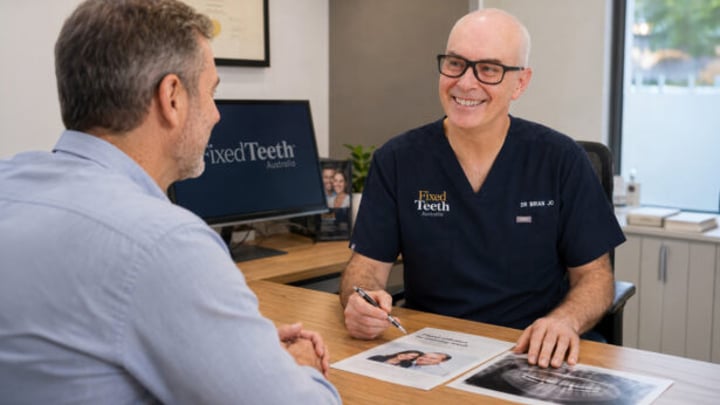
If you’ve lived with missing teeth, failing teeth or troublesome dentures for years, there’s a good chance you’ve wondered about full-mouth dental implants.
It’s also a big decision. There’s the procedure itself to consider, along with cost, recovery, your individual suitability and what happens once the initial treatment is over.
And if you’ve started researching your options, you’ll probably have discovered there’s a lot of information to wade through.
Before deciding whether full-mouth dental implants might be right for you, here are seven questions worth asking.
1. Am I actually suitable for full-mouth dental implants?
This is the logical place to start.
No dental treatment is suitable for everybody, and your general health, oral health and individual circumstances need to be assessed by an appropriately qualified dental practitioner.
An initial consultation with Fixed Teeth Australia is designed to establish what options may be available and whether treatment could be suitable. You don’t have to walk through the door having already decided to proceed.
That may be particularly reassuring for anyone who has put off visiting the dentist because they’re nervous or embarrassed about the state of their teeth. Getting information is not the same thing as committing to treatment.
2. What does the treatment involve from start to finish?
Don’t just ask what happens on the day of the procedure.
Find out how treatment is planned, what happens during the procedure, what you can expect during recovery and whether temporary and final teeth are fitted at different stages.
For people who feel anxious about dental treatment, it’s also worth asking how the procedure itself is managed. Fixed Teeth Australia performs treatment under general anaesthetic, which means you’re asleep during the procedure. This is something that can be discussed during the initial consultation.
The company uses a structured two-bridge process, so ask about the likely number of appointments, healing periods and follow-up visits too. They’re all part of the process and can be important when planning work, travel or other commitments.
3. Who will actually be looking after me?
Full-mouth dental implant treatment can involve several stages and different areas of expertise.
Who conducts the initial assessment? Who performs the procedure? Where are the teeth made? Who handles adjustments? And if you have a concern afterwards, who do you call?
Full-mouth dental implants are the sole focus of Fixed Teeth Australia, with the treatment process coordinated by one team. The company also has an in-house laboratory and uses Australian-made teeth for the ultimate in quality control.
Wherever you seek treatment, you should know who is responsible for each stage of your care.
4. What is actually included in the price?
Two advertised prices can look easy to compare until you examine what they include.
Ask whether the quoted amount covers consultations, scans, the procedure, anaesthesia, temporary teeth, final teeth and follow-up appointments. What about adjustments? And are there circumstances in which extra costs could arise?
Fixed Teeth Australia uses what it describes as a transparent pricing process, with no hidden extras.
The important thing when comparing providers is to understand the complete cost rather than looking at one headline number.
5. Where are my replacement teeth made?
This one can easily be overlooked.
Ask where the dental prosthetics are produced, how the process works and, importantly, how any adjustments are dealt with.
Fixed Teeth Australia has an in-house laboratory team and its teeth are Australian-made.
Knowing how this part of the treatment is handled gives you another piece of information when comparing your options.
6. What if I’m considering treatment overseas?
It’s not difficult to find overseas dental packages promoted to Australians, sometimes at prices considerably below those advertised at home.
But the initial quote isn’t the only consideration.
How many trips will be required? How long will you need to remain overseas? Where will you recover? Who provides follow-up care once you’re back in Australia? And what happens if your teeth need adjusting?
Healing, adjustments, ongoing care and long-term support are among the factors Fixed Teeth Australia recommends considering when comparing overseas and Australian treatment options.
It’s less about deciding that one option is automatically better than another and more about making sure you’re comparing the full process rather than price alone.
7. What happens afterwards?
The treatment day may receive most of the attention, but ask about the months and years that follow.
What follow-up care is provided? How often should you return? What ongoing maintenance is required? And who should you contact if you have a problem?
Fixed Teeth Australia provides ongoing follow-up care in Australia as part of its treatment approach.
If you’re living with failing or missing teeth or unstable dentures and considering full-mouth dental implants, there’s no substitute for asking questions and understanding exactly what’s involved before making a decision.
MORE INFORMATION
If you’re considering full-mouth dental implants and want to understand what may be suitable for you, you can book a no-obligation consultation with the Fixed Teeth Australia team.
Any surgical or invasive procedure carries risks. Before proceeding, you should seek a second opinion from an appropriately qualified health practitioner.
This content is provided for general information only and does not constitute medical or dental advice. Treatment suitability and outcomes vary between individuals. A personalised assessment with a qualified dental practitioner is required to determine what treatment, if any, may be suitable for you.
IMPORTANT LEGAL INFO This article is of a general nature and FYI only, because it doesn’t take into account your personal health requirements or existing medical conditions. That means it’s not personalised health advice and shouldn’t be relied upon as if it is. Before making a health-related decision, you should work out if the info is appropriate for your situation and get professional medical advice.





 Proudly Australian owned and operated