
Born to Be Alive, Currently Deciding Whether to Stay That Way: A Tattoo Removal Diary


I was seventeen in 1979, freshly out of school, and dancing, with what I can only describe as total, unearned confidence, to Patrick Hernandez’s “Born to Be Alive.” I decided, in the way one does at seventeen, that this feeling was permanent, and that the correct response to a permanent feeling was a permanent tattoo. So I had the words BORN TO BE ALIVE inked across my shoulders, in letters large enough to be read from the back row of whatever disco I was next planning to frequent.
I am now sixty-five. I have not thought about Patrick Hernandez in approximately four decades. What I listen to now, almost exclusively, is Sarah McLachlan, at a volume best described as “contemplative,” and the gap between the man who chose that tattoo and the man currently wearing it has become, frankly, embarrassing. I’ve joked that it probably ought to be updated to read LUCKY TO BE ALIVE, which is both medically more accurate at my age and considerably less likely to have me removing my shirt at a barbecue. But honestly, I’d simply rather it wasn’t there at all.
So I did what any self-respecting man of a certain age does when confronted with a decades-old decision he regrets: I researched the exit strategy properly.
What tattoo removal actually involves in Australia
The good news, such as it is, is that removing a tattoo is entirely possible. The less good news is that it is neither quick nor especially cheap, and Australia’s clinics vary enormously in quality, which matters considerably more than I’d have guessed.
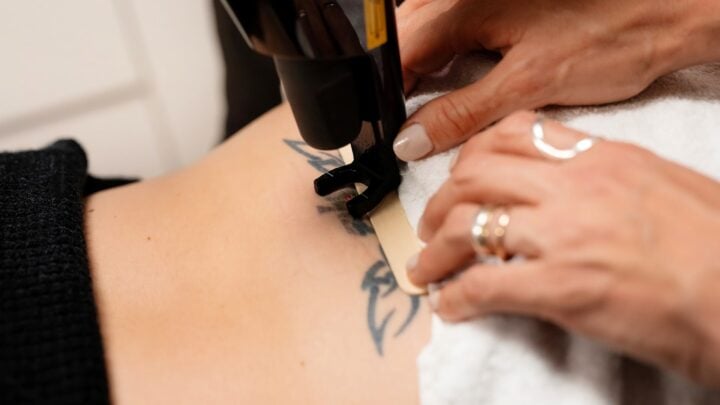
The gold standard is laser removal using Q-switched or picosecond lasers, medical-grade equipment that breaks the ink down into fragments small enough for your own lymphatic system to quietly carry away over the following weeks. Picosecond lasers are the newer, faster technology, delivering pulses a thousand times shorter than Q-switched machines, which can mean fewer overall sessions, particularly for stubborn colours like green, though Q-switched remains a perfectly respectable, decades-proven option at a somewhat lower cost.
Cost genuinely depends on size and colour. A small tattoo might run $150 to $300 a session. Something the size of, say, an entire disco song title spread across both shoulders sits considerably higher, likely $500 or more per visit, and most tattoos require somewhere between six and twelve sessions, spaced six to eight weeks apart, to fade properly. Do the arithmetic and you’re looking at a genuine commitment, both financially and in terms of patience, often stretching across twelve to twenty-four months from first session to bare skin.
As for the sensation itself, it’s commonly compared to a rubber band being snapped against the skin, repeated for anywhere from five to thirty minutes depending on the size of the area being treated. Numbing cream helps, apparently, in about a third of cases. I remain unconvinced this is a ringing endorsement.
Is it safe? Mostly, if you choose properly
Here’s where I’d genuinely urge caution, because the removal industry has its share of operators cutting corners. Reputable clinics use medical-grade Q-switched or picosecond lasers, employ practitioners with proper accreditation, and will happily show you a genuine before-and-after gallery of similar work. Anywhere offering “removal in three sessions regardless of size or colour,” or using IPL, which is genuinely designed for hair and pigmentation rather than tattoo ink, is a place to walk straight back out of. Cheaper, weaker lasers mean more sessions, a higher total cost, and a meaningfully higher risk of scarring or pigmentation changes, which rather defeats the entire purpose of the exercise.
A brief, entirely unsolicited observation
Here is something I’ve noticed while doing all this research, and I offer it with the full awareness that I am, myself, a man who once thought a disco lyric belonged permanently on his own back, so I have absolutely no standing to judge anyone else’s choices. And yet.
I’ve started noticing, at school pickup of all places, a genuinely growing number of grandmothers arriving with full sleeves of tattoos, dropping off or collecting grandchildren from perfectly proper private schools, looking for all the world like they’ve wandered in from an entirely different decade to the one everyone else is having. I want to be clear that I’m trying very hard not to judge this, given my own glass house is currently under active renovation. But there’s a particular, quiet dissonance to it that I can’t quite shake, the sleeve tattoo and the school crest sitting in the same frame somehow refusing to fully agree with each other, at least to my eye, which, again, belongs to a man who is currently paying several thousand dollars to have his own youthful decision surgically dismantled.
Make of that what you will. I suspect the grandmothers in question are considerably more at peace with their choices than I currently am with mine.
Where I’ve landed
I’ve booked a consultation. Twelve to twenty-four months from now, with a bit of luck and a great deal of rubber-band-snapping, my shoulders should be blank again, ready for absolutely nothing, which after sixty-five years feels like exactly the right amount of commitment to make.
IMPORTANT LEGAL INFO This article is of a general nature and FYI only, because it doesn’t take into account your personal health requirements or existing medical conditions. That means it’s not personalised health advice and shouldn’t be relied upon as if it is. Before making a health-related decision, you should work out if the info is appropriate for your situation and get professional medical advice.





 Proudly Australian owned and operated
Comments 2
Join the conversation. Comments are reviewed before they appear.
Not sure if you've seen this info about vision loss starting to show up in people with tattoos! Apparently it's a 'thing'.
https://www.abc.net.au/news/health/2026-02-14/tattoo-eye-inflammation/106315444?utm_campaign=abc_news_web&utm_content=link&utm_medium=content_shared&utm_source=abc_news_web
I am 74 yrs really young ex surfie Mano Mano who is determined in the not too far distant future to have a tat on my right tit oops chest of a dragon-fly, Just deciding where is best for Moi to have the procedure done. Not sure what went wrong at Byron bay 30yrs ago but I have attached to that theirin lighting bolt tat a BCC skin cancer and slow spreading crimson blotch. Mick [email protected]
Join the conversation
Tell us who you are to post a comment. We'll remember you next time.