
You don’t need to be flexible to do yoga. You just need to start


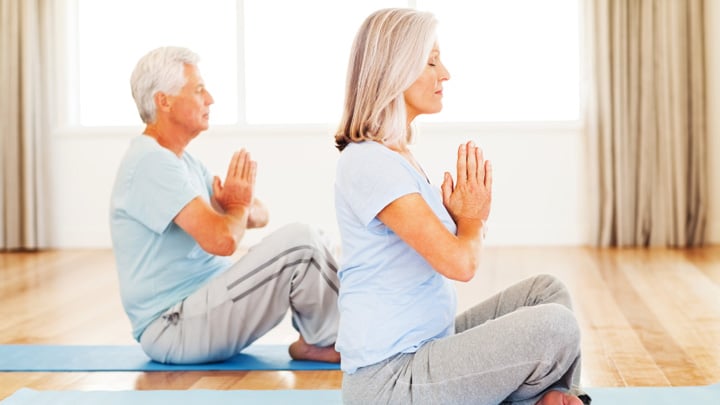
Let’s clear up the biggest myth in wellness right now: yoga is not for people who are already flexible. Yoga is how you become flexible. Those serene humans twisted into impossible shapes on Instagram? They started exactly where you are.
The truth is, yoga might be the single best form of movement available to Australians over 60 – precisely because it adapts to your body rather than demanding your body adapt to it. It improves balance, reduces fall risk, builds strength, eases joint pain, supports bone density, calms the nervous system and has been shown to significantly reduce anxiety and depression. You don’t need to be flexible, athletic, or any particular age to start. Yoga meets you exactly where you are.
The only question is which style suits you best – and that depends almost entirely on where you’re starting from.
The yoga landscape: not all classes are created equal
Walk into the wrong yoga class and you might end up in a heated room doing advanced flows that leave you feeling defeated before you’ve properly begun. Walk into the right one and you’ll wonder why you waited so long. Here’s your guide to the main styles and what each one actually delivers.
Hatha Yoga — The place to start
If you are new to yoga, have limited flexibility or haven’t exercised in a while, Hatha yoga is your answer. Hatha yoga is often the best choice for beginners because it is gentle, slow-paced and focused on basic postures held for several breaths at a time. There is no rushing, no complicated sequences to memorise, and no performance pressure. You learn the foundational poses – standing, seated and lying – with time to understand your body’s response to each one.
A good Hatha class for beginners over 60 should feel accessible, even in the very first session. If it doesn’t, either the teacher needs to offer better modifications, or you need a different class.
Restorative Yoga — For when your body needs permission to rest
This is perhaps the most underestimated style in the entire yoga spectrum. Restorative yoga uses bolsters, blankets, blocks and straps to support the body in passive poses held for five to ten minutes at a time. You are not stretching – you are releasing. The nervous system calms, tight muscles soften and the body begins to let go of tension it has been holding for years.
For anyone managing chronic pain, recovering from illness or surgery, dealing with anxiety or simply exhausted, restorative yoga can feel genuinely life-changing. It is not easy in the way that hard physical things are not easy – it requires a different kind of effort, the effort of surrendering rather than pushing.
Yin Yoga — Deep work for tight connective tissue
Where most exercise targets muscle, Yin yoga targets the deeper connective tissue – ligaments, tendons and fascia – the stuff that gets progressively stiffer as we age. Poses are held for three to five minutes in a relaxed, passive way while gravity does the work of gently lengthening tissue that rarely gets addressed in conventional exercise.
Yin is quiet and meditative, and it is extraordinary for hips, lower back, inner thighs and the spine – precisely the areas that stiffen most noticeably in later life. It pairs beautifully with more active forms of movement and can be genuinely transformative for people who have struggled with chronic tightness for years.
Chair Yoga — The most accessible yoga of all
Chair yoga is exactly what it sounds like: yoga adapted so that every pose is either seated on a chair or uses a chair for support. It is not a compromise or a lesser version – it is a fully valid and often deeply effective practice that allows people with limited mobility, balance concerns, joint replacements or injury to experience the full benefits of yoga safely.
Whether you’re 55 or 85, yoga meets you exactly where you are – and chair yoga is the style that takes that principle most literally. If the floor feels inaccessible, if getting up and down is difficult, or if you simply want to start gently, chair yoga is an excellent entry point that can expand over time as your strength and confidence grow.
Gentle or Senior Yoga — Designed specifically for you
Many studios and community centres now offer classes specifically labelled Gentle Yoga or Yoga for Seniors. These classes combine elements of Hatha, restorative and chair yoga with an instructor who understands the particular physical considerations of an older body – arthritic joints, balance challenges, reduced bone density and the need for longer warm-ups.
If you can find a class specifically designed for over-60s in your area, start there. Consistency is very important in yoga – aim for two to three times per week – and having an appropriate class to return to makes consistency significantly easier.
The styles to approach carefully
A few popular yoga styles are worth approaching with caution if you are new to the practice or have physical limitations.
Bikram or Hot Yoga – practiced in a room heated to 38–40 degrees – can place significant cardiovascular and respiratory stress on the body. While many people love it, it is not recommended as a starting point for older adults or anyone with heart conditions, high blood pressure or heat sensitivity.
Vinyasa or Flow Yoga – characterised by continuous movement linked to breath – can be wonderful but requires a baseline of fitness and familiarity with yoga poses. At the beginner level, it can feel overwhelming and there is less time to find correct alignment, which increases injury risk.
Ashtanga Yoga – a structured, physically demanding sequence practiced at pace – is a committed athletic practice. Extraordinary benefits, but not where you want to begin.
The one thing more important than style
Here’s what experienced yoga teachers will tell you: the style matters less than the teacher. A skilled, experienced instructor who understands older bodies, who offers modifications without making you feel singled out, who creates an environment where you feel safe asking questions – that person is more valuable than any particular yoga tradition.
When you try a new class, notice how the teacher responds when students need to modify a pose. Notice whether they acknowledge that different bodies need different things. Notice whether you feel welcome or whether you feel like you’re not keeping up. You should feel the former. If you feel the latter, find a different class.
The people who start yoga later in life often get the most out of it. They’re not chasing a handstand – they’re showing up for themselves.
That, in the end, is the whole point.
Where to start
Most local councils and community centres offer low-cost or free gentle yoga and chair yoga classes. Yoga Australia (yogaaustralia.org.au) maintains a directory of registered teachers. For home practice, look for instructors who specialise in yoga for seniors on YouTube – there is an abundance of excellent, free, beginner-appropriate content available.
Start with one class. See how your body responds. Give it three or four sessions before drawing conclusions – the first session is often the most unfamiliar, and unfamiliar does not mean unsuitable.
Your body is not too old. It is not too stiff. It is exactly where it needs to be to begin.
IMPORTANT LEGAL INFO This article is of a general nature and FYI only, because it doesn’t take into account your personal health requirements or existing medical conditions. That means it’s not personalised health advice and shouldn’t be relied upon as if it is. Before making a health-related decision, you should work out if the info is appropriate for your situation and get professional medical advice.





 Proudly Australian owned and operated
Comments 0
Join the conversation. Comments are reviewed before they appear.
Be the first to comment.
Join the conversation
Tell us who you are to post a comment. We'll remember you next time.