
Fiona Weir’s homemade yoghurt — the recipe that travelled from a Turkish sailing family to a Tasmanian lighthouse keeper to your kitchen


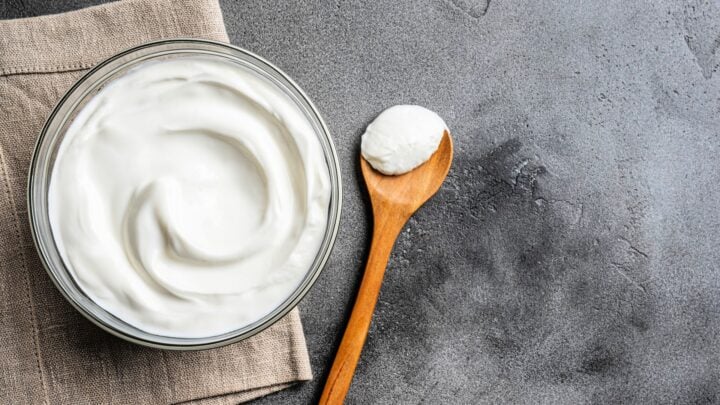
Yoghurt is such an old food. It’s currently right on trend with its high protein and low carbohydrate, but it has actually been around for centuries in different forms. Simple and nutritious, just milk plus culture. Fermented milk appears in all sorts of old places mainly because culturing milk considerably lengthens its life, a valuable trait at any time but priceless pre-refrigeration. Yoghurt is also a step between milk and cheese, milk’s leap towards immortality. And it’s genuinely easy to make at home.
I thought about making yoghurt for a long time as committed from-scratcher before actually doing it as I really balked at the idea of leaving milk to incubate on the bench. I’m the daughter of a dairy farmer and leaving milk out at room temperature to deliberately grow bacteria did not come naturally to me.
People, however, have been leaving milk on benches for generations, safely, producing amazing cultured dairy products and not killing their people with it.
Once I got going, I never looked back.
There are many, many things I love about yoghurt, not the least that it’s full of probiotic cultures, great for gut microbiome, and one of the things that centenarians often say they’ve been eating regularly for their happy healthy hundred years.
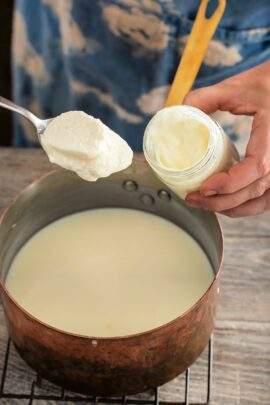
I also love the ‘backslop’ way of making it – so economical. And such an attractive term. You ‘backslop’ some of the last batch into the new batch, therefore transferring the culture. Clever. And simple. You start with a small amount of good quality plain supermarket yoghurt then you can make and remake it for weeks and weeks.
I made it for years this way, and each ‘round’ of yoghurt lasted about seven generations. By that I mean I’d make and remake the yoghurt six or seven times using backslop culture from the previous batch for the next, before the resulting yoghurt would become a bit thin and runny. At that point: buy another ‘starter’ batch from the supermarket.
I realised, after learning about milk kefir and how cultures work, that the yoghurt I was using as starter culture – made on modern freeze-dried starter culture – was yoghurt containing only a few types of specific bacteria, not a lovely robust swathe, the way milk kefir does. What I needed was an old yoghurt starter, an original, that had beautiful, rapidly reproducing, sturdy and long-lasting bacteria in it.
And then, one day, at a cheesemaking course in Sydney, I met a fabulous woman called Pam, from Kangaroo Valley, who mentioned she had an heirloom yoghurt culture. I nearly fainted with joy when she casually offered me some.
Pam’s friends were the National Park’s lighthouse keepers on Deal Island off the north coast of Tasmania when a yacht sailed in, crewed by enthusiastic Aussie yachties sailing around the world. While travelling they’d been given yoghurt by the crew of a boat called Barnacle B. The Barnacle B crew had been in Turkey and met a Turkish sailing family who had a very old family yoghurt on board which had been in the family for hundreds of years. They made fresh yoghurt every week with it, and they shared it with the Barnacle B crew who shared it with the Aussie yachties, who shared it with the Deal Island lighthouse keepers. Pam and her friends christened the yoghurt starter Barnacle B, and that’s how it came to be in my kitchen.
It’s a robust, rich yoghurt full of wildly active bacteria that will make it almost inedibly sour after just two weeks, so needs to be re-made frequently, but it never, ever gives up, stays thick always, and is full of crazy busy bacteria that I hope means my family will all live to be a hundred.
Alternatively, use a good quality natural yoghurt from the supermarket and if it weakens through use, start with another one. You should get about seven generations of yoghurt from it.
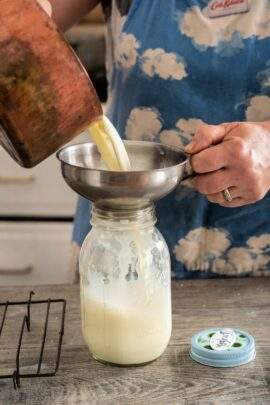
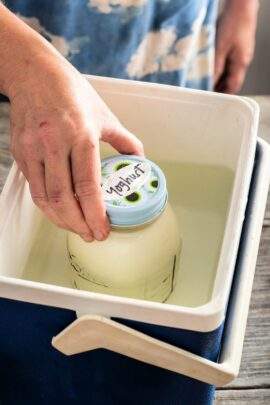
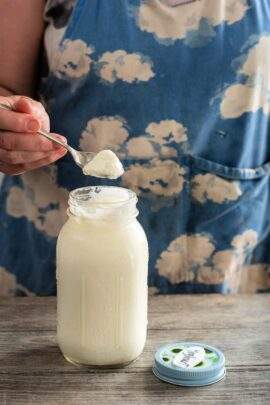
Yoghurt
Makes 1 kg
Ingredients
1 litre (4 cups) full-cream (whole) milk
90 g (⅓ cup) plain yoghurt with live cultures
Method
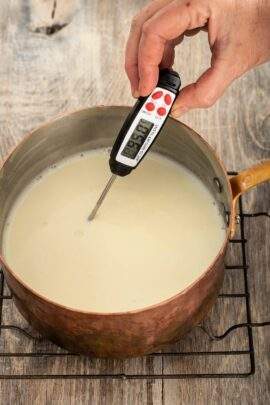
Put 1 litre (4 cups) milk in a saucepan and bring it up to 95°C stirring constantly.
At 95°C take it off the heat and let it cool to 45°C.
Add the yoghurt – this can be from your last batch (‘backslopping’), or any plain yoghurt with live cultures – and stir well or whisk into the cooled milk.
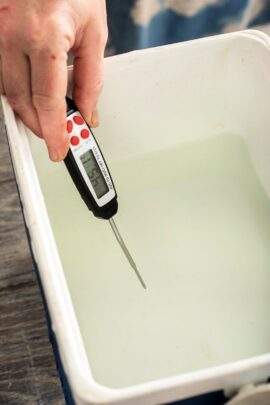
Either put into a yoghurt-maker and follow the setting instructions, or leave in another temperature-regulated environment for approximately 8 hours, or until set (e.g. an esky with 15 cm water at 45° works very well).
After culturing, refrigerate your yoghurt for at least 2 hours before consuming (it will set more firmly).
Note
You can add thickness to your yoghurt by draining additional whey out of it once finished. You do this by pouring the yoghurt into a strainer lined with muslin (cheesecloth) and leaving to drain for 1 hour.
For a sweet yoghurt, add to the warmed and cooled milk:
90 g (⅓ cup) yoghurt with live cultures
75 g (⅓ cup) white sugar
1 teaspoon Vanilla Extract
Stir well and either put into a yoghurt-maker and follow the setting instructions, or leave in another temperature-regulated environment for approximately 8 hours, or until set. Refrigerate for at least 2 hours before consuming.
Trouble-shooting
If you want to cool your milk quickly because, you know, you have a life to get back to, don’t pour it into another container from a height – you’ll end up with too much aeration. Just sit the saucepan in a sink of cold water until the temperature comes down to 45°C.
Don’t stir the yoghurt as it is setting, or you’ll break up the structure and it will be runny. You can stir it after it is set (stir honey or maple syrup into it at this point if you choose), but the yoghurt will be thinner and may need to be strained through muslin (cheesecloth) to thicken it up a bit.
If you check your yoghurt at eight hours and it’s still runny you can safely leave it incubating for up to twenty-four hours, and it will usually thicken.
The less ‘messed with’ the milk is, the thinner the yoghurt. This has to do with how pasteurisation rearranges the proteins in the milk. What this means is that UHT milk actually makes the thickest yoghurt – I’m not advocating for using UHT milk but just so you know, you can!
You can incubate yoghurt a hundred different ways. We like the esky method, but I’ve seen people incubate yoghurt in dehydrators, in water baths in an oven with a pilot light on, wrapped on top of woodstoves, and a friend of a friend made it in prison in a rice cooker set on warm. Perhaps some unfortunate life decisions, but excellent gut health.
Home-made yoghurt is cheap, it’s easy, it’s delicious and it’s probiotic.
And you could probably incubate it on a kitchen bench wrapped in a warm blanket if you don’t suffer the dairy girl genetics that I have that make me smell every single bottle of milk every time I make a cup of tea. What is that?
Recipe adapted from Fiona’s book “From Scratch” published by Hardie Grant 2022, photography by Alan Benson





 Proudly Australian owned and operated
Comments 0
Join the conversation. Comments are reviewed before they appear.
Be the first to comment.
Join the conversation
Tell us who you are to post a comment. We'll remember you next time.