
Lessons That Last: Smells that take us straight back to school


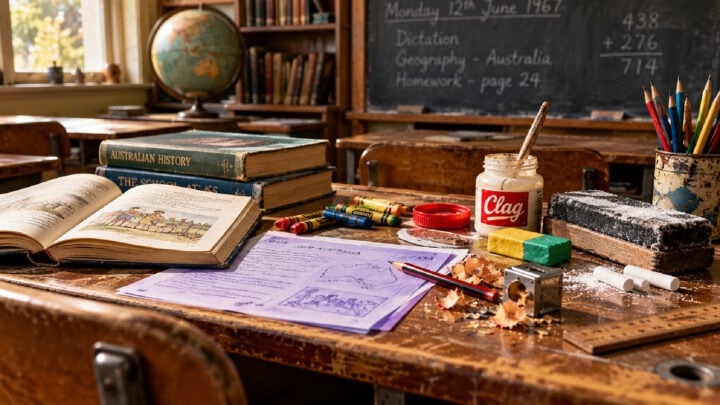
Every now and then I’ll catch a smell that has no business taking me back to primary school.
Freshly cut grass can do it, and so can an old library book, chalk dust or that unmistakable whiff of disinfectant. Suddenly I’m back in a classroom, on the oval or standing outside the sick bay, and the strange thing is that the smell often arrives before the memory does.
Schools had their own collection of smells, and some of them have stayed with Australian kids for the best part of 100 years.
So, with apologies to anyone reading this over breakfast, here is my honour roll.
Chalk, ink and a freshly sharpened pencil
Chalk dust has to be close to the top. It gathered along the bottom of the blackboard, coated the teacher’s fingers and became embedded in those old dusters that occasionally had to be taken outside and belted together. One good whack and you disappeared inside a white cloud.
For earlier generations there was ink, with fountain pens, stained fingers and inkwells built into old wooden desks. Ink had an extraordinary ability to travel from the pen to your fingers, shirt, exercise book and just about anywhere else it wasn’t supposed to be.
I can still smell a freshly sharpened wooden pencil, too, particularly when it came out of one of those big metal sharpeners fixed to a desk or wall. Add crayons, Textas and a new exercise book and you’ve got a pretty good approximation of a primary-school classroom.
The art room
Clag deserves its place here. That familiar bottle with the brush attached to the lid was responsible for generations of school projects, many of which probably contained considerably more glue than was structurally necessary.
Older readers may remember Perkins Paste, while Plasticine brought another smell entirely — slightly oily and waxy, and somehow still on your hands long after you’d finished using it.
Poster paint belongs here too, along with brushes sitting in murky jars of water, crayons and sheets of damp paper drying around the room.
Nobody ever released a fragrance called Double Art, Tuesday Afternoon.
Probably wise.
Ahhh, the duplicator
Now here’s one I reckon will unlock a few memories.
Before photocopiers became commonplace, schools used duplicating machines including Gestetners and spirit duplicators. Those purple or blue copies had a smell all of their own, particularly when they were fresh.
A pile would be handed around the room and some of us gave the page a sniff before we started.
You know who you are.
The library produced another distinctive mixture: old paper, dusty shelves, book coverings and carpet. Even now, opening an old book can take me straight back there.
For some older readers, polished timber floors, old wooden desks and the smell of a wood heater might belong in the same memory.
The ones we could have lived without
School milk has earned its place on this list for very different reasons.
Generations of Australian kids remember bottles arriving in metal crates, and if the milk was properly cold, everything was fine. Unfortunately, milk that had spent a little too long warming up on an Australian day could develop a personality of its own.
Wet wool wasn’t much better. Put a classroom full of kids in damp jumpers and blazers on a rainy winter morning and opening a window wasn’t going to save you.
The sick bay had its mixture of disinfectant and vinyl, while the school toilet block produced a fragrance so distinctive that you generally knew you were approaching it before you could see it.
We’ll leave that one be.
Is it lunchtime yet?
Long before you reached the tuckshop or canteen, you could often smell what was happening inside.
Hot pies and sausage rolls were warming somewhere while you sat in class watching the clock crawl towards lunchtime. If you had sandwiches in your schoolbag while somebody else had a lunch order coming, that smell seemed very unfair.
After last week’s tribute to the brown paper bag, I probably don’t need to explain what it did to a hungry schoolkid waiting for his pie.
Especially one whose bag didn’t arrive.
Outside had its own smells
Freshly mown grass on the school oval is right up there for me. Throw in eucalyptus, dusty ground and a hot afternoon and I can picture the place.
I remember the smell of bitumen after rain too, particularly when showers arrived after a warm day and the smell seemed to rise straight off the playground.
And chlorine and sunscreen. School swimming lessons could finish hours earlier and you’d still smell the pool on yourself when you got home.
Every school probably had something particular to where it stood.
Mine certainly did.
And one that was all mine
At my little country school, I’d add one more that probably won’t appear in too many perfume catalogues.
Cow poo.
We were surrounded by dairy country and, strange as it sounds now, I remember the fresh smell drifting across from the paddocks as oddly sweet. I still don’t find it unpleasant. It smells like home.
I’ve forgotten whole lessons from those school years and plenty of things teachers spent weeks trying to drum into my thick head.
But give me an old library book, freshly cut grass, a whiff of chalk dust or, apparently, a nearby cow paddock, and I’m back there.
You can almost hear the bell.
This article is part of ‘Lessons That Last’, a new Starts At 60 series exploring the memories, traditions and school experiences that shape Australians across generations, presented in partnership with Schoolblazer Limited, a specialist school uniform company that works with hundreds of schools internationally. Through Lessons That Last, Starts At 60 is exploring the memories and experiences of school life across generations of Australians.
Also check out LESSONS THAT LAST: SMILE IT’S SCHOOL PHOTO DAY!





 Proudly Australian owned and operated
Comments 0
Join the conversation. Comments are reviewed before they appear.
Be the first to comment.
Join the conversation
Tell us who you are to post a comment. We'll remember you next time.