
10 things every Australian kid spent their pocket money on


There was a time when having 20 cents rattling around in your pocket could make you feel independently wealthy.
You might have earned it by mowing the lawn, washing the car, doing the dishes or tackling whatever other household job your parents had decided deserved financial reward. Some kids received a regular allowance, while others relied on the time-honoured generosity of grandparents quietly slipping them a coin when Mum wasn’t looking.
However it arrived, pocket money was serious business because once it was yours, you got to decide what happened to it.
There were no online purchases, subscriptions or games asking you to buy another bundle of imaginary coins and you stood at the milk bar with real money in your hand, staring at everything within your price range and weighing up one of the biggest financial decisions of your young life.
So, how much did you get, and where did it go?
-
A bag of mixed lollies
This was where 20 cents could perform miracles.
You’d tell the person behind the milk bar counter how much you had and watch closely as your little white paper bag was filled one lolly at a time. Milk bottles, freckles, snakes, teeth, bananas, raspberries and whatever else took your fancy all went in.
The walk home usually involved telling yourself you’d save some for later, but most of us arrived home with an empty bag.
-
Footy cards
Buying footy cards was only the beginning because the real action happened at school.
You’d tear open the packet hoping for one of your heroes, discover yet another duplicate and immediately start working out who might trade for it. Deals were negotiated at lunchtime with the seriousness of AFL list managers. Two ordinary players for one star? Throw in another card and we might have a deal.
Some kids had enormous collections and others seemed to own 14 copies of the same full-back.
-
Icy poles
On a hot afternoon, the freezer at the local milk bar was almost impossible to walk past.
Sunnyboys, Razzes, Paddle Pops and all manner of frozen delights waited under that sliding glass lid while you tried to make a decision before the shopkeeper told you to close the bloody thing.
Whatever you chose, it usually melted faster than you could eat it and left your hands sticky for the rest of the afternoon.
-
Comics and magazines
Before a screen filled every idle moment, a comic could occupy you for hours.
Choosing one was half the fun, particularly when buying it meant sacrificing a sizeable chunk of that week’s pocket money. Once home, though, it would be read repeatedly, passed around between friends and eventually end up dog-eared in a pile somewhere in your bedroom.
Nothing was disposable when you’d paid for it yourself.
-
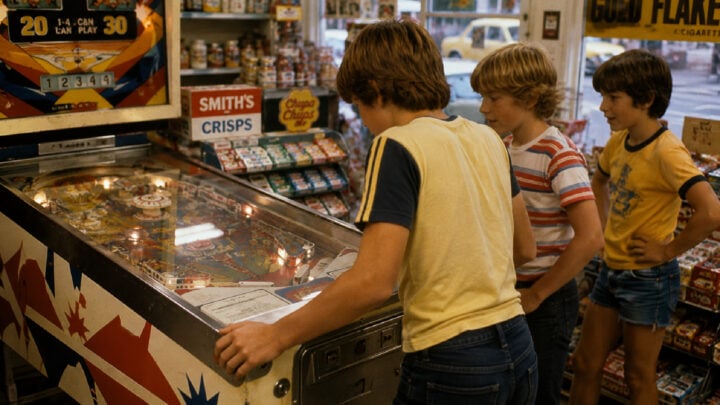
Pinball and arcade games
A few coins in your pocket made the pinball machine at the fish-and-chip shop dangerously attractive.
Later came Space Invaders, Galaga and the other arcade machines that swallowed money at an alarming rate.
You could spend an entire week earning your pocket money and then watch it disappear in minutes because you were absolutely certain the next game would be the one where everything finally came together… it rarely was.
-
A proper milkshake
This was serious spending.
A milk-bar milkshake wasn’t something you grabbed without thinking: it was a treat, preferably made in one of those metal containers that somehow made everything taste colder.
Chocolate, strawberry, vanilla or the gloriously artificial blue heaven were among the big decisions, and if you were lucky enough to get the remaining milkshake in the metal cup as well, you’d hit the jackpot.
-
Records and singles
This was where the savers separated themselves from the spenders.
Buying a record meant resisting the milk bar for several weeks while the coins slowly accumulated in your money box. Eventually came the magnificent day when you could walk into the record shop, hand over your own money and leave carrying the single or album you’d been wanting.
There was something different about buying it yourself: you’d saved long enough to get it, so that record was important.
-
Fish and chips
Pooling pocket money with your mates opened up an entirely new economic model.
A serve of minimum chips seemed capable of feeding an astonishing number of children, particularly once the parcel was opened and everyone started grabbing.
If the budget stretched to potato cakes — or potato scallops, depending on where you grew up — you were doing exceptionally well.
Nobody was discussing carbohydrates; we were too busy fighting over the crunchy bits at the bottom.
-
A bottle or can of soft drink
Buying your own soft drink felt oddly grown-up.
Coke, Fanta, Tarax, Passiona, Solo and plenty of regional favourites all had their devotees, and the glass bottle somehow made everything taste better.
Better still were the days of refundable bottles. An empty bottle wasn’t rubbish; it had monetary value and could be returned to help fund the next round.
We were running a circular economy before we knew what one was.
-
Saving for something BIG
Some children possessed a level of financial discipline the rest of us found deeply suspicious.
While we were converting every available cent into lollies, they were feeding coins into a money box for weeks or even months.
The target might have been a cricket bat, roller skates, a footy, cassette player, new bike or something else far beyond the reach of a single week’s allowance.
There was no instant gratification involved. You watched the money slowly build until the day finally came when you could afford it, and because getting there had taken so long, the thing you bought tended to mean an awful lot more.
Honourable mentions…
Naturally, pocket money looked different depending on where and when you grew up.
There were marbles, yo-yos, Matchbox cars, chewing gum, sherbet, stickers, cheap jewellery, hair clips and all sorts of little treasures that seemed desperately important at the time. Country kids had the general store, coastal kids could lose their fortune at the beach kiosk or amusement arcade, while suburban milk bars had an almost supernatural ability to separate children from their money.
Then there were those kids who put virtually everything they received into their money box. We all knew one, and frankly, the rest of us couldn’t understand them.
Looking back, what strikes you isn’t how little we had to spend, but how much those few coins seemed to be worth.
Pocket money gave you a tiny taste of independence. It taught you that buying one thing usually meant going without another, and occasionally that blowing the entire week’s allocation on lollies wasn’t quite as clever once Saturday afternoon rolled around.
Mind you, standing outside the milk bar with a bulging bag of mixed lollies in your hand, it certainly felt like money well spent.
How much pocket money did you get, and what did you spend it on? Tell us in the comments.





 Proudly Australian owned and operated
Comments 2
Join the conversation. Comments are reviewed before they appear.
I used to get 20c pocket money. I would buy black blocks which were 4 for a cent back then lasted all weekend yum
I would get 3d (threepence) and I would get tuppence worth of sherbet and a penny licorice stick and happily wet the licorice stick and place it in the bag of sherbert - the rest was sheer heaven.
Join the conversation
Tell us who you are to post a comment. We'll remember you next time.