


By Kat Wong and Tom Wark
Tough new laws will see symbols of hate banned and NSW police empowered to demand people of interest remove face coverings during public events.
Premier Chris Minns has also promised a potential doubling down on the ban of hateful slogans.
Legislation underpinning the measures in the wake of last weekend’s deadly Bondi terror attack will be introduced to NSW parliament on Monday.
Mr Minns said the laws would make it an offence punishable by up to two year’s jail or a $22,000 fine for anyone publicly displaying terrorist symbols including ISIS flags.
The penalty would increase to $110,000 where an organisation became involved in any wrongdoing.
While face coverings currently only have to be removed for police to confirm someone’s identity post-arrest, the new restrictions would mean the threshold would be lowered to include all suspects.
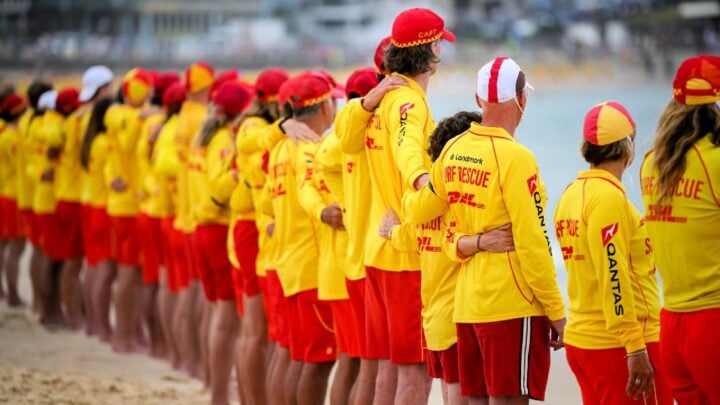
The announcement of the measures follows an outpouring of solidarity by Bondi’s lifesaving community on Saturday morning.
Hundreds of volunteers stood hand in hand with the beach’s world-famous lifeguards, lining almost the entire kilometre-long shoreline.
The red and yellow front, punctuated by the lifeguards in blue, paid tribute to the 15 civilians killed during Sunday’s Hanukkah celebrations at Bondi.
Their two-minute silence hung heavy over the beach, as the rhythm of the waves beat against the sand bank.
“The emotions are extremely raw for everyone and it’s very hard,” Waverley Council lifeguard services co-ordinator Daniel McLaughlin said.
“We do a lot of training knowing these emotions are the normal reaction to a horrific, traumatic event.
“But that doesn’t make it easy.”
Volunteers hugged and cried together in the aftermath of the silence, many reflecting on the people around them touched by the shocking violence.
Members of the Bondi Surf Life Saving club and lifeguards ran into the fray on Sunday when they heard the gun shots ring out.
Some offered shelter while others provided medical care to those who had been shot.
Many are still decompressing from the events, and Mr McLaughlin acknowledged it would be some time before a sense of normalcy returned to the beach.
But he refused to focus on the negative.
“The Australian spirit of bravery and pride came out that day,” the lifeguard said.
“As a community, we will show strength and plant that foot forward and keep going.”
Victims of the shooting are still being treated, with 15 remaining in hospital.
The NSW government is also set to introduce snap changes that will give the police commissioner powers to suspend the state’s protest authorisation system after a terrorism incident.
The declaration would last two weeks and could be renewed for up to three months.
It could be applied to specific locations or statewide.
But the proposed laws, set to be rushed through a special sitting of NSW parliament next week, are likely to be immediately tested in court.
“These are far too broad powers for the police commissioner,” NSW Council for Civil Liberties president Tim Roberts said.
“The banning of protests will not stop anti-Semitism.”
Jews Against the Occupation ’48 and Greens MP Sue Higginson also came out against the changes.
“Restricting the civil liberties of all Australians due to the actions of two depraved terrorists with guns is not conducive to social cohesion,” Ms Higginson said.
Jewish peak bodies have praised the changes but say more needs to be done to combat anti-Semitism specifically.
“The right to protest is an Australian value but so is letting us come together without harassment and intimidation,” NSW Jewish Board of Deputies president David Ossip said.
NSW parliament struck down other protest restrictions earlier this year.
When asked if he was confident his new laws could withstand a court challenge, Mr Minns insisted they were robust.
The state’s Supreme Court can hear urgent applications, including protest matters, every day of the year.





 Proudly Australian owned and operated
Comments 0
Join the conversation. Comments are reviewed before they appear.
Be the first to comment.
Join the conversation
Tell us who you are to post a comment. We'll remember you next time.