
Could yoga help lower your blood pressure? New research says it might be worth rolling out the mat


If you have been told your blood pressure is too high, you are far from alone. In Australia, it is one of the most common health concerns for people in their 60s, 70s and beyond – and one of the most serious. Raised blood pressure is the leading risk factor for preventable deaths in Australia, contributing to over 25,000 deaths annually, mainly due to stroke, heart disease and kidney disease.
Nearly 39 per cent of Australians aged 65 to 74 have measured high blood pressure, rising to nearly 43 per cent of those aged 75 and over. And perhaps most sobering: only 32 per cent of Australians with hypertension have it under control.
Medication is the most common treatment, and for many people it is essential and effective. But researchers have long been interested in what lifestyle changes might offer on top of – or alongside – a prescription. And a substantial new study published this month has added an intriguing piece of evidence to that puzzle.
What the research found
A research team from the University of Edinburgh and Universitas Gadjah Mada in Indonesia conducted a meta-analysis – a study that pools data from multiple previous studies – examining 30 separate trials of yoga and its effects on heart health. Across those 30 studies and a total of 2,689 participants, all of whom had a body mass index indicating they were overweight or obese, the researchers found that people who practised yoga showed a significant decrease in blood pressure.
On average, systolic blood pressure – the top number in a blood pressure reading – fell by 4.35 mmHg. Diastolic blood pressure – the bottom number – fell by 2.06 mmHg. They also found modest beneficial effects on cholesterol levels, including both the LDL (low-density lipoprotein) and HDL (high-density lipoprotein) types that are associated with stroke risk.
To put that blood pressure reduction in context: a drop of 4 to 5 mmHg in systolic pressure is considered clinically meaningful. While it is not the same as medication, it is the kind of reduction that, sustained over time, can make a real difference to cardiovascular risk.
The study was published in the open-access journal PLOS Public Health on April 22.
What the researchers are actually claiming — and what they are not
It is important to be clear about what this research does and does not tell us, and the authors are admirably honest about this.
This was a meta-analysis – meaning the researchers looked at patterns across existing studies rather than conducting a new clinical trial themselves. Because of the nature of this type of study, causality cannot be confirmed. The research shows a correlation between yoga practice and lower blood pressure, not proof that yoga caused the change.
The studies analysed were also not specifically recruiting people with obesity, the participants were predominantly from Asian countries, and people with pre-existing conditions like diabetes or heart disease were excluded. So it is not yet clear whether similar benefits would apply to all populations – including Australian women and men in their 60s and 70s with other health conditions.
The studies they examined also did not measure a dose-response – meaning we do not yet know exactly how much yoga is needed to produce these effects. The research did note, however, that the studies tended to favour practice of at least 180 minutes per week – roughly three one-hour sessions.
The authors themselves put it plainly: “Our review suggests that yoga may offer a helpful additional option for improving some aspects of cardiometabolic health in adults with overweight or obesity, particularly blood pressure.” They add that “yoga is often seen mainly as a wellbeing practice, but our findings suggest it may also support certain cardiometabolic health outcomes.”
The word “may” is doing important work in those sentences. This is promising, early-stage evidence – not a prescription.
Why this matters specifically for people over 60
There is a particular reason this research resonates for older Australians. The combination of high blood pressure and carrying excess weight around the middle is extremely common in the 60-plus age group, and managing both through lifestyle can feel daunting – especially if the options on the table involve high-intensity exercise that feels inaccessible or unsafe.
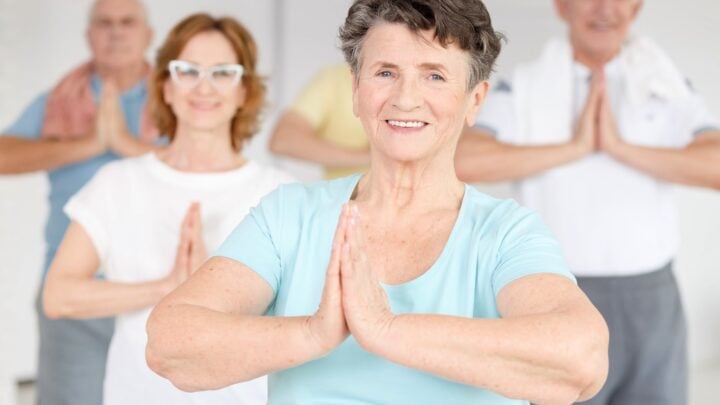
Yoga is different. It is low-impact, highly adaptable, and increasingly available in forms specifically designed for older bodies. Chair yoga, gentle yoga, restorative yoga and yin yoga all make the practice accessible to people with limited mobility, joint pain or balance concerns. You do not need to be flexible to start – that is rather the point.
And Australians over 60 are already discovering this. Australian research tracking yoga participation over a decade found that among the oldest age group (55 years and over), yoga participation increased significantly – from 0.7 per cent in 2001 to 2.7 per cent in 2010 – and that trend has continued strongly since. Yoga and flexibility training are now among the top recommended activities for older adults, with global fitness trends placing programs for people over 60 in the top three exercise priorities for 2025.
A sensible way to think about it
The researchers describe yoga as a potential “add-on” to existing heart health strategies – not a replacement for medication or for the other lifestyle factors your doctor has likely already discussed: diet, salt reduction, weight management, limiting alcohol, not smoking and regular movement.
If you are already on blood pressure medication, please do not stop or adjust it without speaking to your GP. And if you are considering starting yoga, particularly if you have existing health conditions, it is worth mentioning it to your doctor first, especially if you are going to be attending in-person classes.
But for those who have been looking for a form of exercise that is gentle, restorative, social and backed by a growing body of health evidence – this new research offers another reason to give it a go.
Most community centres, YMCAs and gyms offer beginner or seniors yoga classes, often at low cost or as part of a membership. Many yoga studios offer chair yoga or gentle yoga specifically designed for older adults and those new to the practice. Online classes, including free sessions on YouTube, make it easy to try at home before committing to anything.
You do not need a mat. You do not need special clothes. You do not need to be able to touch your toes. You just need thirty minutes and somewhere comfortable to sit or stand.
This article is general in nature and does not constitute medical advice. Always consult your GP before making changes to any treatment or exercise routine, particularly if you have existing health conditions.





 Proudly Australian owned and operated
Comments 0
Join the conversation. Comments are reviewed before they appear.
Be the first to comment.
Join the conversation
Tell us who you are to post a comment. We'll remember you next time.