
Bondi massacre lies swirl around the internet


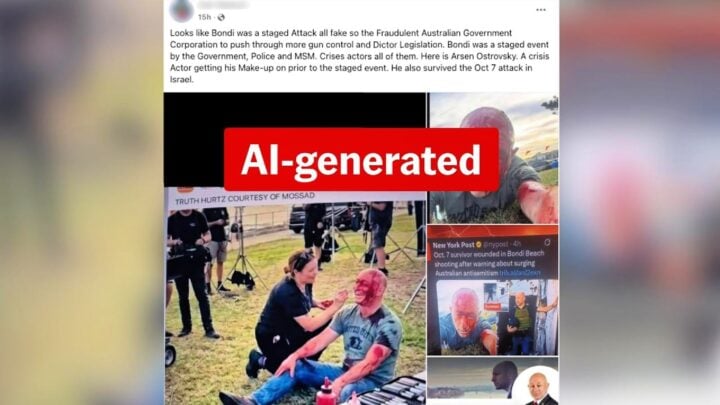
Misinformation in the aftermath of the Bondi terrorist attack has been rife yet challenging to frame in terms of motive
However research into its proliferation especially alongside fake news trends pre-dating the atrocity suggests something more than online players fabricating content just for clicks.
Claims seeking to establish bogus identities for the December 14 gunmen and the man who disarmed one of them, to assertions the deadly assault was a false-flag operation continue to circulate.
The spread of doctored images and videos, both domestically and internationally, has been copious though deliberately obtuse.
Beyond dispute is that, inspired by Islamic State ideology, Sajid Akram, 50, and his son Naveed, 24, deliberately targeted a Jewish Hanukkah event when they opened fire and killed 15 people at Bondi Beach.
The older man was killed, and his son wounded and charged with murder and terrorism offences.
The variety of misinformation and disinformation generated since has also been substantial, says AAP FactCheck editor Ben James.
Artificial intelligence has been used extensively to spur the harmful content, including photos purporting to show crisis actors having fake blood applied before the attack, and synthetic audio placing bogus statements in the mouths of a police chief, premier and prime minister.
AI has made it easier to generate more authentic looking written posts too.
But where has it come from?
“There are signs of what appears to be a co-ordinated overseas disinformation effort exploiting this horrific event,” James says.
“In particular, we have identified a network of disinformation Facebook pages operated from Vietnam, as revealed by their page transparency details.”
False claims alleging Israeli involvement have also gained “limited but measurable traction within Australia”, according to NewsGuard staff analyst Ines Chomnalez.
The website ratings service calculates there have been almost 1000 mentions of this claim on social media since December 14.
There have also been accounts of the massacre in Pakistan and India seeking to spread misinformation about the nationality of the attackers, seemingly linked to geopolitical tensions between the south Asian neighbours.
Sajid Akram was initially identified as a Pakistani national, before authorities clarified he was an Indian citizen, while his son is Australian.
Pro-India accounts began pushing the narrative the Akrams were Pakistani and had travelled to Pakistan before the mass shooting during the initial confusion over their origins.
A fake statement by the Pakistani government circulated on social media seemingly confirmed the pair had travelled to Pakistan ahead of the attack.
Meanwhile, pro-Pakistan accounts published false claims about the gunmen being linked to India’s foreign intelligence agency.
Although enlightening, these posts had minimal reach among Australian-based accounts, Chomnalez says.
“The fact many claims linking the attack to Pakistan or Israel were amplified primarily by accounts outside of Australia suggests the users advancing them are unlikely to have firsthand knowledge,” she says.
Even so, James points out that it has become increasingly easier to generate misinformation with simple prompts that would once have needed a team of writers with detailed insight of Australian events.
Things like the capacity to understand the concerns of local audiences and ability to craft content designed to be widely shared.
“It is also becoming increasingly difficult to distinguish AI-generated text from human-written content,” James adds.
AAP FactCheck reporter Matthew Elmas points to known disinformation pages on Facebook, which, in the lead up to Bondi, primarily focused on false claims about elite swimmers and LGBTQ issues.
This all pivoted sharply in the weeks prior to the shootings, in late November, to posting disinformation about Australian politics.
This second wave of content was often shared thousands of times, Elmas says, and typically featured fabricated quotes from One Nation leader Pauline Hanson and other politicians criticising the Albanese government.
Since December 14, daily posts about the Bondi event have sought to amplify the fallout with fake quotes from Senator Hanson and former prime minister John Howard among others.
While the odd pattern of content doesn’t explain motive, it’s certainly curious that one misinformation campaign suddenly ceased as another began, and then immediately morphed into a fresh deluge as soon as Bondi erupted.
While anything but random, is it reasonable to see the traffic as a pattern of disinformation-for-hire?
Perhaps but James is not yet convinced.
“It may simply be an attempt to capitalise on a tragic event to drive engagement and advertising revenue,” he says.
“But it is also possible there is more to it. At this stage, we cannot say for certain.
“What is clear is that Australians are being exposed to disinformation on a troubling scale.”





 Proudly Australian owned and operated
Comments 0
Join the conversation. Comments are reviewed before they appear.
Be the first to comment.
Join the conversation
Tell us who you are to post a comment. We'll remember you next time.