
Are red-and-yellow beach flags still fit for purpose?


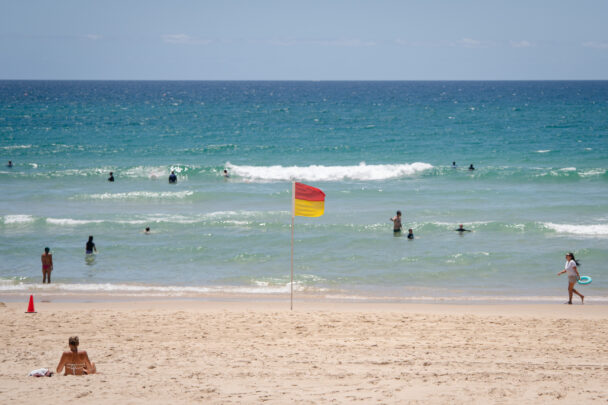
Australia’s iconic red and yellow beach flags, long a symbol of surf safety, may be confusing international visitors and contributing to rising drowning rates, prompting renewed calls for changes to how beach safety is communicated.
Each summer, millions of people visit Australia’s beaches. Thousands require rescue by lifeguards, surfers or bystanders, and every year lives are lost along the coast. The red and yellow flags are intended to provide a clear message – to swim within a safe, patrolled area of water, while surfers are expected to remain outside the flagged zone.
However, research by the University of New South Wales and Monash University in Melbourne suggests that for many people born overseas, the meaning of the flags is not clear. Studies show international students often misinterpret what the flags indicate, rely on visual cues such as where others are swimming, or assume calm-looking water is safe.
The red and yellow system is not universal. Around the world, beach safety is communicated using different colours, symbols and patrol arrangements. Despite ongoing efforts by water safety organisations, drowning rates in Australia continue to rise, with people born overseas accounting for a significant proportion of fatalities.
The red and yellow flags have been part of Australian beach safety since the 1930s, marking areas monitored by professional lifeguards or volunteer surf lifesavers. Flags are typically placed away from rip currents, which are responsible for an average of 26 drownings a year and most surf rescues.
Yet despite more explanatory information posted at surf clubs and beach entrances, recent studies indicate widespread misunderstanding. About 70% of South Korean university students and 60% of Japanese students surveyed believed the red and yellow flags marked a dangerous area. A study in the Netherlands found only 3.4% of participants correctly interpreted the flags, while about 40% thought they denoted danger.
Researchers say this confusion aligns with other global safety systems, where red commonly signals danger or prohibition and yellow signals caution. Even among Australian university students, around half incorrectly believed surfers should also stay between the flags, despite surfers being expected to remain outside the swimming area.
Internationally, beach flag systems vary widely. In countries such as Brazil, Spain and parts of the United States, a traffic-light system is common, with green indicating safe conditions, yellow caution, and red signifying danger or closure. Portugal sometimes adds purple flags to warn of marine stingers. In parts of northern Spain, yellow flags may mark designated “cooling off” areas, even when red danger flags are also displayed.
The International Life Saving Federation recommends a global set of eight beach safety flags, including red and yellow for patrolled swimming areas, red for high hazard, yellow for medium hazard, and black and white for watercraft zones. The federation discourages the use of green flags to indicate safety, arguing that no beach can ever be completely risk-free.
Language also plays a role in misunderstanding. While many Australian beaches display signs instructing visitors to “swim between the flags”, research at Bondi Beach in Sydney found around 30% of overseas-born beachgoers misunderstood the message. Some believed it meant only confident swimmers should go between the flags, and that weaker swimmers should stay outside the patrolled area.
Researchers and safety experts are now considering potential changes. A recent European study tested a modified red and yellow flag that included a pictogram of a lifesaver, nearly doubling participants’ correct understanding of the flags. Some experts have also suggested changing the wording from “swim between the flags” to “stay between the flags” to avoid cultural and linguistic misunderstandings around the word “swim”.
While simply changing the colours of flags may not be enough, researchers say Australia’s strong lifesaving tradition should not prevent testing new approaches, including whether green flags or additional symbols could improve beach safety communication.





 Proudly Australian owned and operated
Comments 0
Join the conversation. Comments are reviewed before they appear.
Be the first to comment.
Join the conversation
Tell us who you are to post a comment. We'll remember you next time.