


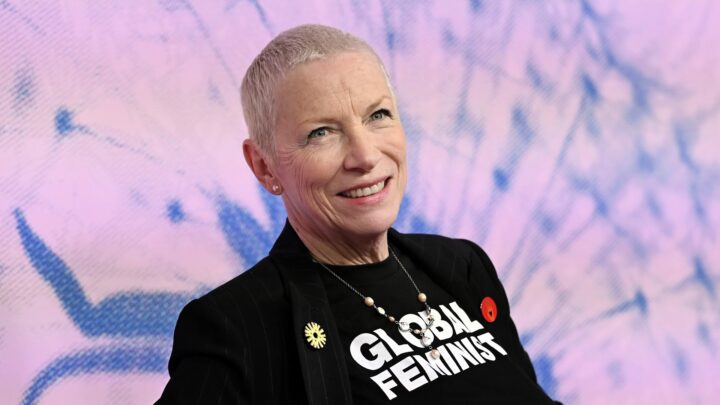
When Annie Lennox decided the time was right to strip away the glamour, the myth and the stage lights, she reached for not a microphone but a book. Annie Lennox: Retrospective, published in September 2025 by Rizzoli, is not the usual tell-all autobiography. Instead it is a visual memoir: over 200 photographs, archival Polaroids, music-video stills and album-cover shots that trace her journey from a working-class childhood in Aberdeen to one of pop’s most enduring figures.
In recent interviews Lennox has spoken candidly about neurodivergence, the male-dominated music industry, her iconoclastic style and the necessity of reflection after decades of defying expectation.
“I wanted to perform as a woman, not be regarded as a piece of meat”
From the moment she and Dave Stewart stepped onto a stage as Eurythmics, their image declared war on conformity. “I wanted to perform as a woman, but I didn’t want to be regarded as a piece of meat.”
Growing up in Aberdeen, Scotland, she says, the messages around her were stark. “They would say, ‘If you don’t stick at it at school, you’ll end up in a factory.’ … My teachers were quite mean and very strict. And those voices are still in my head.”
That sense of pressure, of being measured against a narrow set of expectations, seems to have fuelled her refusal to fit. The suits, the half-shaved head, the bold androgyny: all part of a visual strategy to claim space rather than be claimed. As she told Vogue, when asked why now felt right for a book: “After COVID, I started thinking about things – and my age (she’s 70) – and I was like, ‘It’s now or never.’ I might as well do it now!”

The archive becomes the self
This is not a memoir that opens with “I was born …” and ploughs linearly through years of albums. Instead the book works like a gallery, a curated selection of moments: a six-year-old Lennox singing in school, the first time she found khaki shorts at a Scottish village fair.
She told Interview Magazine that being left-handed, her tendency to work “back-to-front”, her ADHD-diagnosis (at age 70) even, have all shaped her archive mindset: “I’ve always done things in a ‘back-to-front’ kind of way.”
The resulting book, she says, is “a souvenir of frozen moments … A memento – a souvenir – A life lived through imagery and sound.”
The narrative choices are revealing: the emphasis isn’t just on success, but on identity, on how the image is inseparable from the music. “Each album, video and photograph has its own identity and style … Retrospective could actually have been presented in many different ways.”
Neurodivergence, activism and the unfinished story
What adds depth to this retrospective is the personal layer now emerging in Lennox’s discourse: she was diagnosed as neurodivergent after being tested for ADHD and “passing with flying colours.”
“I veer off on tangential roads, down rabbit holes … I’m not interested in taking Ritalin or whatever people take,” she says.
Talking with Lennox, the theme of activism again takes precedence: beyond the music, Lennox has long been invested in gender equality and social justice, and the book captures images of her with icons and world-figures that underline this.
She is quick to remind that the story isn’t over. She speaks about future ambitions: writing film-scores, exploring creative collaborations, keeping the momentum alive. “I still really am a creative person.”
Working-class roots, icon-status and fashion as defiance
Lennox’s story begins in a modest household: “I was born towards the end of Christmas Day in 1954 at Summerfield Maternity Hospital … in the city of Aberdeen.”
Yet her journey led her to venues and stages the world over. She reminisces about hunting for clothes in charity shops in Scotland: “I used to go on Saturday afternoons… it was like finding treasure.”
Style, for Lennox, has always been political. “I never had big teams of stylists, and I didn’t want that,” she says. “When you don’t have things in great supply and huge budgets, you find ways to be creative.”
And those creative choices become shorthand: the suits, the orange crop haircut, the bold gaze – gestures that declared control when many artists, especially women in the eighties, had little of it.
Reflection, but not retirement
What’s striking about this book, and about the interviews Lennox is giving, is the absence of sentimentality. Yes, there is deep reflection, the acknowledgment of vulnerability, the long cast of collaborators and struggles. But she is not pausing to rest.
The visual memoir is both a celebration and a recalibration: a way of owning the story before someone else tells it, of stepping back into the archive and saying “this is me”. And yet the final pages suggest there is still space ahead, still music to make, still stories to tell.
“Nothing is ever guaranteed from one moment to the next.”
Why the book matters
At a time when pop-history is often rewritten by others, this is a first-person reclaiming of narrative by one of its most distinctive voices. For fans of Lennox’s music – from the haunting sleight-of-hand of Sweet Dreams (Are Made of This) through to her solo epics – the book offers fresh vantage points: the image behind the album cover, the childhood self standing in for the performance self.
For women in creative industries, it’s a reminder that the path to visibility – particularly for someone who rejected the expected path of a pretty-pop-princess—can be circuitous, messy, inventive. She did not conform; she transformed.
And for anyone interested in memory and identity, the interviews reveal how the visual archive is not neutral. It’s a battleground for meaning. “There have been thousands of photographic images floating around in the zeitgeist throughout the decades of my life as a performer,” she says. “In a way, each one serves as part of the picture-puzzle narrative of my story.”





 Proudly Australian owned and operated