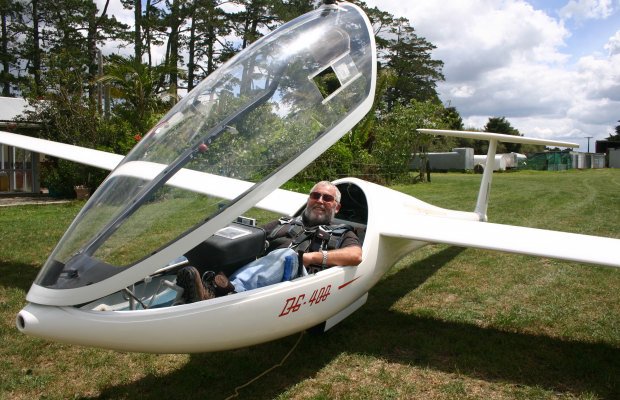
One of the great fears of the glider pilot is “Landing Out”! This doesn’t mean landing the aircraft while sitting on the wings, it means landing away from the home airfield, on a strange piece of unfamiliar land, something that never happens to a powered aircraft unless it’s crashing, but in the case of a glider it can occur all too often.
Most people know that a glider stays airborne because of what are known as “thermals”. Thermals are bubbles of warm air that develop in certain conditions, such as hot sunshine on a ploughed field, where surrounding fields are covered in grass. The grass cools the air drifting over it and so it stays stable, but when the air passes over a ploughed field, which lacks the cooling effect of the grass, the air warms up – and we all know that warm air rises. That is a thermal!
Of course, if the sun stops shining, the air is no longer warmed over that ploughed field and the result…no thermals! Put a glider in the middle of that thermal and suddenly, the poor glider pilot is left with no means of staying airborne! Then he has to “land out”!
This is when things get scary, especially if the glider is only about a thousand feet up! The pilot has about three minutes to frantically search the ground below him and select a field that he considers big enough to land in. (If he happens to be flying over the Mullundung Forest at the time – well he’s really out of luck!) Given that there are fields below, he then has to pick one not only big enough, but one with the right crop in it. Land in a field full of three foot tall hay or corn and he’ll most likely get his wings torn off; land in a marsh and in all probability he’ll sink. And above all, look out for cattle! They can be very inquisitive and many a pilot has gone for help, only to return and find cows sitting on his plane, quietly eating the fuselage. And don’t forget, all these judgments have to be made from about a thousand feet above the ground, in little more than seconds! Watching the surface of a hay field can give some indication of its growth – tall grass tends to look like rippling water from the air, while a marsh usually has puddles all over the place.
Having selected your field and voiced a prayer that it was a wise choice, there is one important rule – always land on the near side, not close to the far hedge! This is because a glider, like any other plane, needs room to slow down and stop after it arrives on the ground! Land on the near side and you have room, on the far side you finish in the hedge with a broken plane.
We’ve landed safely, now for the next problem. Who owns the field and where does he live? About all you can do is to look for the nearest house and knock on their door. They will either tell you who the landowner is, offer the use of their telephone or point a shotgun and yell at you to get off their land.
Finally, having sorted out all these problems, you have to get friends from your airfield to bring the plane’s trailer to you, so you can completely dismantle it and put it away to take home.
So….always, always, always try to avoid landing out!